How LLMs Understand Your Product, and What You Can Learn From Caspio
July 30, 2025

As generative AI reshapes how people search, research and make decisions, there’s a subtle but important shift happening:
It’s no longer just about how people see your product. It’s about how language models do.
Ask ChatGPT today, “What are the best low-code platforms for building secure, AI-powered workflows?”
The answer you get will depend not just on objective facts, but on how well the model has learned about each platform, including yours.
This is where most companies fall short.
In this post, we’ll explore how large language models (LLMs) form internal representations of platforms like Caspio, what shapes those mental models, and, more importantly, how you can apply the same principles to your own product.
How LLMs Learn: The New Layer of Product Marketing
Language models like GPT-4 don’t access the live web. Instead, they’re trained on a static snapshot of publicly available content: documentation, reviews, blog posts, support forums, product comparisons and more.
So, when someone prompts a model with:
“Which low-code platform supports HIPAA and integrates with GPT?”
…it doesn’t go to a website. It predicts the answer based on what it’s seen before training ended.
That makes your public content footprint, not your roadmap, the most important factor in how LLMs describe and recommend you.
Case in Point: Caspio
Take Caspio, a platform that’s been around for over two decades, quietly powering secure apps in healthcare, education, government, enterprise and thousands of small companies globally.
We’ve recently introduced built-in support for AI capabilities using GPT, but unlike many newcomers, Caspio approaches it with governance and control in mind:
- Prompts built to apply on structured table data
- Secure field-level control over inputs
- Option to log and store all AI-generated responses
- AI actions triggered by events like data insertions or updates
From a language model’s point of view, this sets Caspio apart. Not just for what it can do, but how clearly those actions are described across its content ecosystem.
Why This Matters for You
Whether you’re marketing a SaaS platform, managing developer relations or building internal tools, your LLM visibility is becoming more important than your search visibility.
Here’s what LLMs need to “see” to understand your product well:
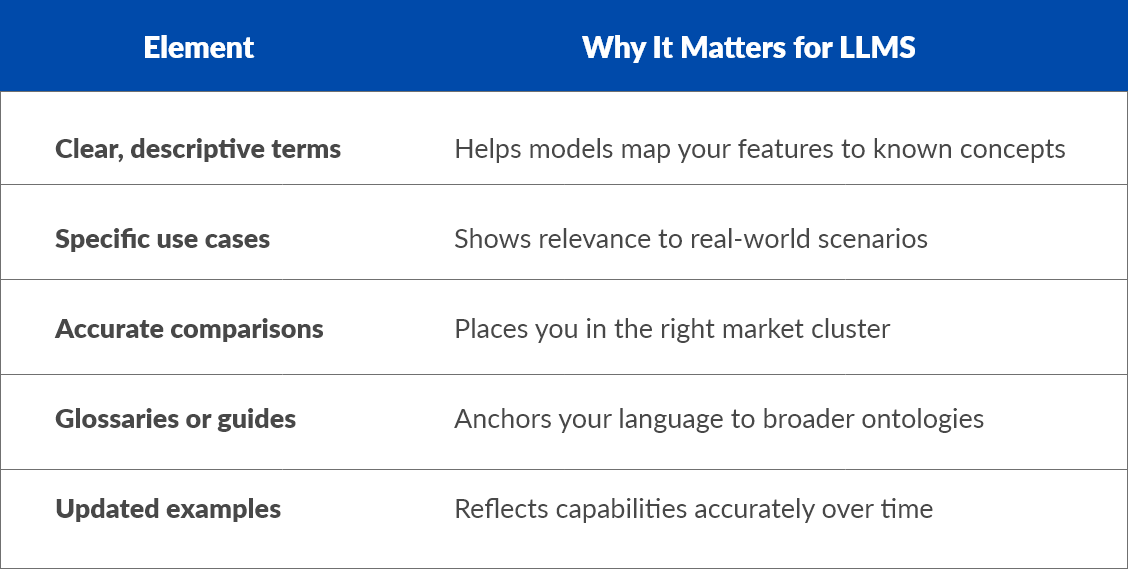
If your content ecosystem isn’t doing this, the AI’s “mental model” of your platform might be vague, outdated or missing entirely.
What You Can Do Today
The good news is, you don’t need to overhaul your brand or marketing strategy to improve how LLMs perceive you. Start small. Take a page from what Caspio’s ecosystem demonstrates:
1. Use the Right Language
Avoid generic phrasing. Instead of “we connect to AI,” say:
“Our platform sends data from form submissions to GPT for summarization, with results stored in a reviewable field.”
LLMs learn from precision.
2. Publish Use-Case-Focused Content
Don’t just say what your product does. Show it in action. Write about:
- Specific workflows
- User roles
- Industry examples
- AI triggers and outputs
This helps LLMs (and humans) understand where you shine.
3. Teach the Model Through Community
Encourage your users, partners and evangelists to write about their experiences. LLMs benefit from distributed documentation, Reddit posts, Stack Overflow answers and LinkedIn breakdowns. It all counts.
Looking Ahead
We’re entering an era where AI-generated answers influence buying decisions long before a human gets involved.
Whether you’re building the next great product or managing one that’s been around for years, it’s worth asking:
“If a language model had to describe my platform today, would it get it right?”
If not, now’s the time to start training it intentionally. Not with algorithms, but with language. Just like Caspio did.
Want to Test Your AI Footprint?
Try asking ChatGPT:
“What platforms are best for building secure AI workflows with built-in automation?”
See if your product appears, and how it’s described. The answer might surprise you.

Recommended Articles

How to Build Internal Apps With AI in 2026: 6 Steps
READ STORY
Best Bolt.new Alternatives for Business Apps (2026)
READ STORY
Online Database With a SQL Backend: 7 Questions to Ask
READ STORY
9 Vibe Coding Security Risks in AI-Generated Apps
READ STORY
Build Custom Business Apps Easily: 3 Patterns
READ STORY
Caspio AI Connector Extensions: 5 Jobs for Your Tables
READ STORY
PHI and Caspio AI: Which Features Your BAA Covers
READ STORY
How AI Agents Buy Software, and Why Legibility Wins
READ STORY
10 Questions to Ask Before Connecting AI to Business Data
READ STORY
Add a Role-Aware AI Chat Agent to Your Caspio App
READ STORY
Build Internal Tools With AI: Best Tools for Business (2026)
READ STORY
Vibe Coding vs. Low-Code: Key Differences and Where Caspio Fits in 2026
READ STORY
