Building Internal Tools Without Developers: What IT Departments Actually Approve
November 5, 2026

IT approves a business-built internal tool when seven questions are answered: sign-in and identity, access to records, an activity record, data location and infrastructure, independent verification, connections and permissions, and, new in 2026, AI governance.
On a governed platform such as Caspio, most of them are answered once, by the platform, not per tool. Caspio is an AI platform for building custom business applications, and this article uses it to walk through each check. The IT lead gets the checklist with the reasoning behind each item, while the builder gets the packet that turns a review into a yes.
Why Business-Built Tools Stall at IT
A business-built tool rarely stalls at IT because of poor quality. More often, no one can answer IT’s questions about it, leaving IT unable to approve it. The UK’s National Cyber Security Centre has a name for tools that end up in that gap: shadow IT, “the unknown assets that are used within an organisation for business purposes”.
The questions are not arbitrary. They come from the control frameworks IT is measured against: NIST SP 800-53, the CIS Controls, ISO/IEC 27001, and the SOC 2 trust services criteria all test identity, access, logging, data protection, supplier assurance, and system connections, which is why the same list appears in every serious review.
One thing changed in 2026. AI now builds and edits internal tools, so IT has added a seventh question that older checklists lack. The tool itself is still built the same way; our earlier article walks through the six-step method.
7 Questions IT Asks Before They Approve an Internal Tool
The table is the whole list, and the sections below explain each row. The right-hand column shows what Caspio provides, within the scope the platform itself states.
| What IT asks | What a tool built on Caspio answers |
|---|---|
| Who can sign in, and how do they leave? | SAML single sign-on on plans that include it; users managed in Caspio Directories or from your identity provider; administrators deactivate leavers |
| Who can see and change which records? | Role-based access and record level security, defined once and enforced from the interface to the API; Caspi generates the roles |
| Is there a record of who did what? | Activity logs on every plan; a full audit trail of all data access in the HIPAA and Compliance edition |
| Where does the data live, and who runs the infrastructure? | Caspio-operated AWS hosting, six residency regions, encryption in transit and at rest; database encryption at rest in the HIPAA and Compliance edition |
| Has anyone independent checked the platform? | An independent third party re-examines the platform every year; status public at trust.caspio.com, full reports under NDA |
| What does it connect to, and with what permissions? | REST API, webhooks, and integration platforms; API connections start with no permissions on existing data until granted |
| What did the AI build, and is it governed the same way? | Caspi generates data model, interface, and roles; people and Caspi edit one application under the same permissions and audit trail |
1. Who Can Sign In, and How Do They Leave?
Why IT asks: Account management and a unique, authenticated identity for every user are the first things any access-control audit tests.
What Caspio answers: Users are managed in Caspio Directories or from your identity provider, with SAML single sign-on on plans that include it. Two-factor authentication is available for application users on every plan, and for the people who build in the Caspio account on plans that include it. Caspio can also act as a SAML-out identity provider (IdP) for third-party applications, so the accounts managed in Caspio can govern access to other apps in your stack. For leavers, an administrator sets the user to inactive or suspended, and disabling an identity provider blocks sign-in for every user on it.
2. Who Can See and Change Which Records?
Why IT asks: Least privilege has to be enforced by the system, not promised by the builder; it is what an audit tests right after identity.
What Caspio answers: Inside every application, role-based access and record level security controls determine who sees what, and access follows least-privilege roles you define once and enforce everywhere, from the interface to the API. A record-level rule compares a field on the record, such as owner, assignee, or department, with the signed-in user’s profile, so each person sees only the records that belong to them. Caspi generates the roles with the application, so who sees what is part of the build, not an afterthought.
3. Is There a Record of Who Did What?
Why IT asks: Without a record of who did what, nothing can be investigated or proven, which is why logging is its own control family.
What Caspio answers: All Caspio plans include logs for user access, emails, SMS, and account activity. The access logs record sign-ins, failed sign-ins, password changes, two-factor events, and application access, with the source IP, device, and browser. The HIPAA Edition and Compliance Edition add a full audit trail that tracks all data access, read, write, edit, and delete, through deployed applications, APIs, and the account.
4. Where Does the Data Live, and Who Runs the Infrastructure?
Why IT asks: Jurisdiction, encryption, and who patches the servers are the first questions on every cloud questionnaire.
What Caspio answers: Caspio runs on AWS with data residency in the United States, Canada, the European Union, the United Kingdom, Australia, and South America. Data is encrypted in transit and at rest, and the HIPAA and Compliance editions add database encryption at rest on separate compliant infrastructure. Caspio operates, patches, and backs up the infrastructure, and there is no generated codebase for the builder to host, secure, or patch.
5. Has Anyone Independent Checked the Platform?
Why IT asks: IT cannot take a vendor’s word for any of the above; it needs an independent assessor and evidence it can read.
What Caspio answers: HIPAA, SOC 2 Type II, and GDPR compliance are independently audited annually. The status is public at trust.caspio.com, and the full reports are shared under NDA through the Trust Center, which is standard practice for reports of this kind.
6. What Does It Connect to, and With What Permissions?
Why IT asks: Every connection is a second system with its own permissions, so IT approves the exchange of data, not just the tool that holds it.
What Caspio answers: Caspio integrates through its REST API, webhooks, Zapier, Make, n8n, and Keragon for healthcare. A new API profile has no permissions on existing Caspio data until an administrator grants them, table by table and view by view, and API connections can be limited to listed IP addresses. The same zero baseline governs AI tools that reach the data through the Caspio MCP Server. AI Connector Extensions process records as they arrive and write results back to the field you selected.
7. What Did the AI Build, and Is It Governed the Same Way?
Why IT asks: This is the 2026 addition. CISA’s May 2026 guidance on agentic AI names privilege creep and obscure event records among the risks, so IT wants AI under the same identity, access, and logging controls as a person.
What Caspio answers: Caspi, Caspio’s AI app builder, generates the data model, interface, and roles as one application. People and Caspi then edit that same application under the same permissions and audit trail, so nothing the AI builds sits outside the controls IT has already reviewed. The Chat AI Agent answers signed-in users’ questions about the application’s data within each user’s role permissions, with field-level security on top. For the risks inside AI-generated code, see our article on vibe coding security risks.
What IT Approves Once, and What It Reviews for Every Tool
Most IT departments do not review every tool from scratch. They approve a platform once, for the checks that belong to the platform: sign-in and identity, access enforcement through roles and record-level rules, activity logs, hosting, data residency, and encryption, independent verification, connection permissions that start at none, and AI edits under the same rules. Then they review each tool for what changes per tool: the roles for this tool and who sees which records, the data it holds, the systems it connects to, a named owner and a backup, and a pilot with real roles.
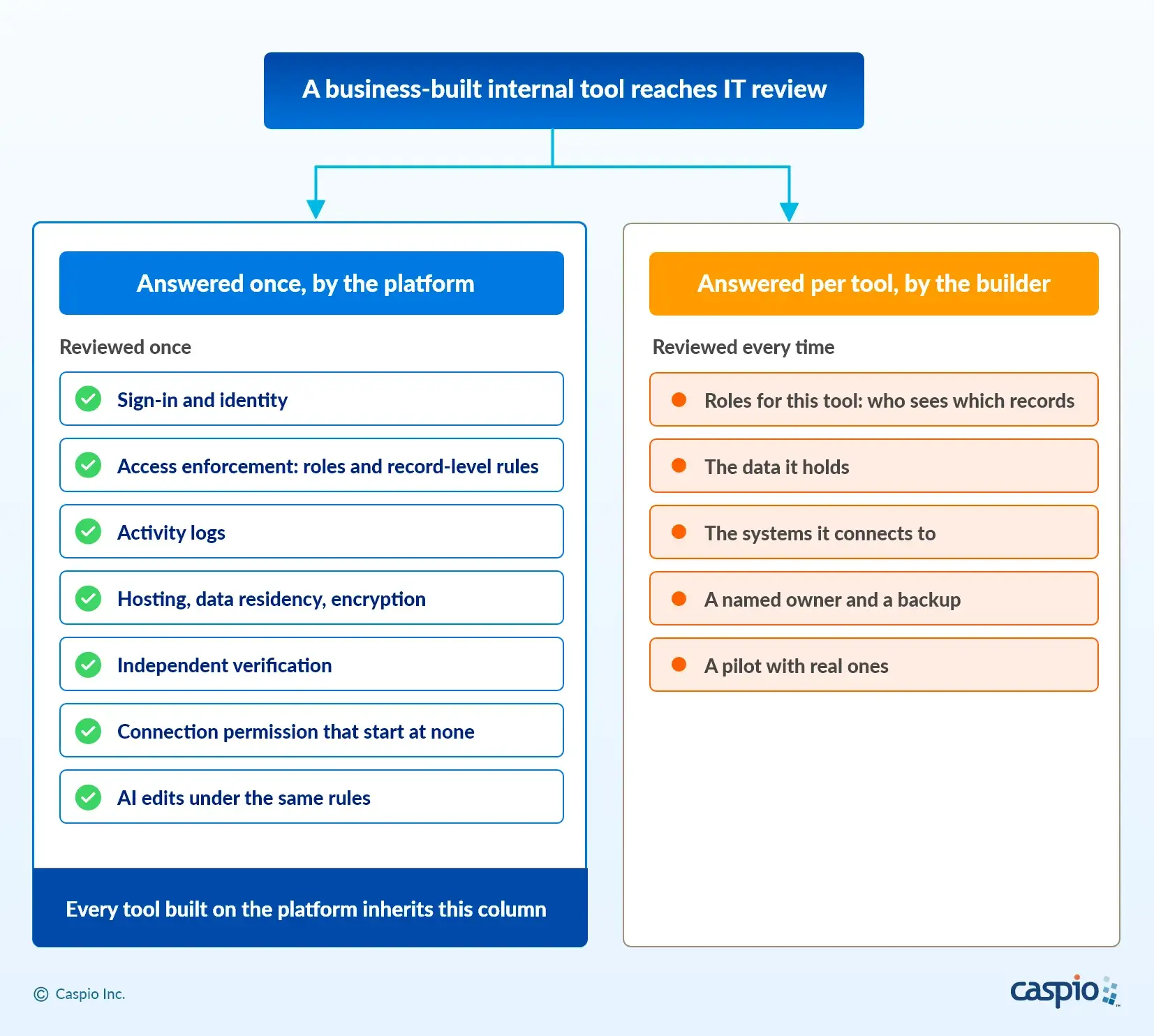
WHO ANSWERS WHAT: The IT approval checklist for a business-built internal tool, split by who answers it: the platform, once, or the builder, for every tool. With Caspio, the platform supplies the left column.
Every tool built on Caspio inherits the once-answered column, and every later edit, by a person or by Caspi, inherits the same security. Caspio delivers a compliant app in a compliant environment. Regulated industries are the hardest test, not the only fit; the same platform serves any company that values security, reliability, and scalability. If the tool will hold regulated data, the Caspio HIPAA Edition is the starting point.
How to Get IT Approval for the Tool: What to Bring
A packet gets a quicker yes from IT than a demo does. Bring these six items:
- The workflow, written down: the records, the people, the rules, and the statuses.
- The roles table: who sees and changes what. On Caspio, this is what Caspi generated and you confirmed.
- The data classification, in plain words: what kind of data the tool holds, and whether any of it is regulated.
- The connections list: which systems, and in which direction the data moves.
- A named owner and a backup administrator.
- The platform’s evidence: the Compliance page and the Trust Center, so IT is not asked to take your word for the platform.
Then, run the pilot in front of IT. Sign in as each role and show that each one sees only what it should. If you would rather not build it yourself, have us or one of our many certified partners build it for you, and Caspio Support is there throughout.
Frequently Asked Questions
What does IT check before approving an internal tool built by a business team?
IT checks mainly seven things: sign-in and identity, access to records, an activity record, data location and infrastructure, independent verification, connections and permissions, and AI governance. On Caspio, the platform answers the platform-level checks once; the builder brings roles, data, connections, an owner, and a pilot for each tool.
Can a business team build an internal tool without developers that IT will approve?
Yes, when the platform can answer IT’s questions. On Caspio, Caspi generates the application with its roles from the first version, and the platform provides single sign-on on plans that include it, activity logs on every plan, AWS hosting with data residency, and independent verification every year. The team’s part is the per-tool packet: roles, data, connections, an owner, and a pilot.
Does Caspio support single sign-on?
Yes. Caspio supports SAML single sign-on on plans that include it, with users managed in Caspio Directories or from your identity provider, such as Microsoft Entra ID or Okta. Caspio can also act as a SAML identity provider for third-party applications. Two-factor authentication is available for application users on every plan.
Does an application built by AI need a separate security review?
No separate review is needed on Caspio. Caspi builds and edits inside the same application as a person, under the same permissions and audit trail, and there is no generated codebase to review. IT reviews the tool’s roles, data, and connections as it would for any tool.
Start With the First Tool
Start a free 14-day trial and build the first tool where IT’s questions are already answered, with unlimited users included. Send IT the Compliance page and the Trust Center, or see the four AI capabilities on the Caspio AI page. If your team already builds internal tools on Retool, see how Caspio compares as a Retool alternative.

Recommended Articles

Best Bubble Alternatives for Business Apps (2026)
READ STORY
Best App Builders for Small Medical Practices
READ STORY
Best Knack Alternatives (2026): AI and Compliance
READ STORY
Secure AI Code Generation: 10-Point Checklist
READ STORY
How to Build Internal Apps With AI in 2026: 6 Steps
READ STORY
Best Bolt.new Alternatives for Business Apps (2026)
READ STORY
Online Database With a SQL Backend: 7 Questions to Ask
READ STORY
9 Vibe Coding Security Risks in AI-Generated Apps
READ STORY
Build Custom Business Apps Easily: 3 Patterns
READ STORY
Caspio AI Connector Extensions: 5 Jobs for Your Tables
READ STORY
PHI and Caspio AI: Which Features Your BAA Covers
READ STORY
How AI Agents Buy Software, and Why Legibility Wins
READ STORY
