Best App Builder for a Small Medical Practice: A 2026 Buyer’s Guide
October 29, 2026
An app builder for a small medical practice is a platform that lets a practice with no IT staff create secure apps for patient intake, scheduling, referral tracking, and staff checklists, under a signed BAA, without a software project. The best app builder for a small medical practice signs a BAA on a plan the practice will actually buy, runs without IT staff, and puts a person on the other end of support at any hour.
Best for: Independent and private practices, clinics with 1 to 10 providers, specialty, dental, physical therapy, and behavioral health practices, and the IT contractors and consultants who support them.
In a small medical practice, the office manager often doubles as the IT department: managing the front desk, following up with payers, and keeping the practice’s software running. According to the AMA’s analysis of its 2024 Physician Practice Benchmark Survey, 42.2% of U.S. physicians worked in private practices, defined as practices wholly owned by physicians. For small offices, the priority is software that simplifies daily work without adding another system to manage.
The EHR does not do everything. It holds the chart and the bill, while intake packets, referral follow-up, recall lists, and opening checklists live on paper, in spreadsheets, and in email. This guide covers who signs the BAA, six weighted criteria, and five platforms small practices shortlist: Caspio, Knack Health, Jotform, Google AppSheet, and Blaze. Caspio fits best when patients use your apps and you want certified compliance and support at any hour, though it is not the cheapest fit.
What Is an App Builder for a Small Medical Practice?
An app builder for a small medical practice, sometimes called an app builder for a doctors’ office, is a hosted platform where practice staff create the secure forms, databases, and workflows the office needs, then share them with staff and patients. Five apps come first:
- Patient intake and consent: Registration, medical history, and consent forms saved directly to a secure database rather than scanned packets.
- Appointment scheduling: A staff-managed appointment and shift calendar with a patient request form.
- Referral tracking: Incoming and outgoing referrals tracked by status, receiving provider, and next follow-up date.
- Patient lists and follow-up queues: Recall lists and callbacks assigned to responsible staff. Learn what to include in HIPAA-compliant forms for healthcare organizations.
- Staff checklists: Opening and closing tasks, equipment checks, and credential renewals tracked with due dates.
App builder or practice management software? Keep your EHR or practice management system as the system of record for charts, billing, and claims. An app builder fills the gaps around it, the workflows your EHR does not cover. If you are shopping for an EHR, this is the wrong category.
What Makes a Small Practice Different
For a small practice, the right app builder must fit the budget and daily workflow without adding work for an already busy team. These priorities shape what to look for.
No IT staff means the vendor runs the platform. Hosting, updates, and security have to be the vendor’s job, because nobody in the office has time to own them.
Total monthly cost, including HIPAA, is the real price. Platforms charge for HIPAA in different ways: a separate plan, an add-on, or per-user fees on top. Budget the total with a signed BAA in place.
Setup has to be fast. The person building the intake app also answers the phones, so templates and AI-assisted building matter most.
A few specific apps beat a platform program. Private practice apps need to get intake, referrals, and a checklist working this quarter, not deliver a transformation roadmap.
Compliance work lands on the office manager. The vendor’s certification covers the platform. Risk analysis, access decisions, staff training, and vendor paperwork stay with the practice, usually with the person who runs the schedule.
Who Signs the BAA, and What Your Practice Still Owns
Under HIPAA, a practice may let a vendor create, receive, maintain, or transmit protected health information (PHI) on its behalf once it has written assurances that the vendor will safeguard it (45 CFR 164.502(e) and 164.308(b)(1)). That agreement is the Business Associate Agreement (BAA). Caspio signs it with your practice through the HIPAA add-on. Caspio’s HIPAA-eligible AI features operate under signed BAAs.
A signed BAA alone does not ensure compliance. Caspio’s platform is independently certified each year for HIPAA, SOC 2 Type II, and GDPR, providing a foundation for compliant apps. Your practice remains responsible for:
- A security risk analysis: An accurate and thorough assessment of risks to your electronic patient data, plus measures to reduce them (45 CFR 164.308(a)(1)(ii)(A) and (B)). The HHS Security Risk Assessment Tool (SRA Tool) is built for small and medium providers.
- User roles and access: Unique logins and written policies on who can see which patient data (45 CFR 164.308(a)(4) and 164.312(a)).
- Staff training: Security awareness training for the whole workforce, including management, and privacy training for all staff, with new hires trained soon after they join (45 CFR 164.308(a)(5)(i) and 164.530(b)).
- A BAA with every other vendor: Your EHR, email, fax, texting, and integration vendors each need one if they handle patient data.
- AI assistants you connect yourself: An AI assistant connected through the Caspio MCP Server needs your practice’s own BAA with that provider before it touches patient data.
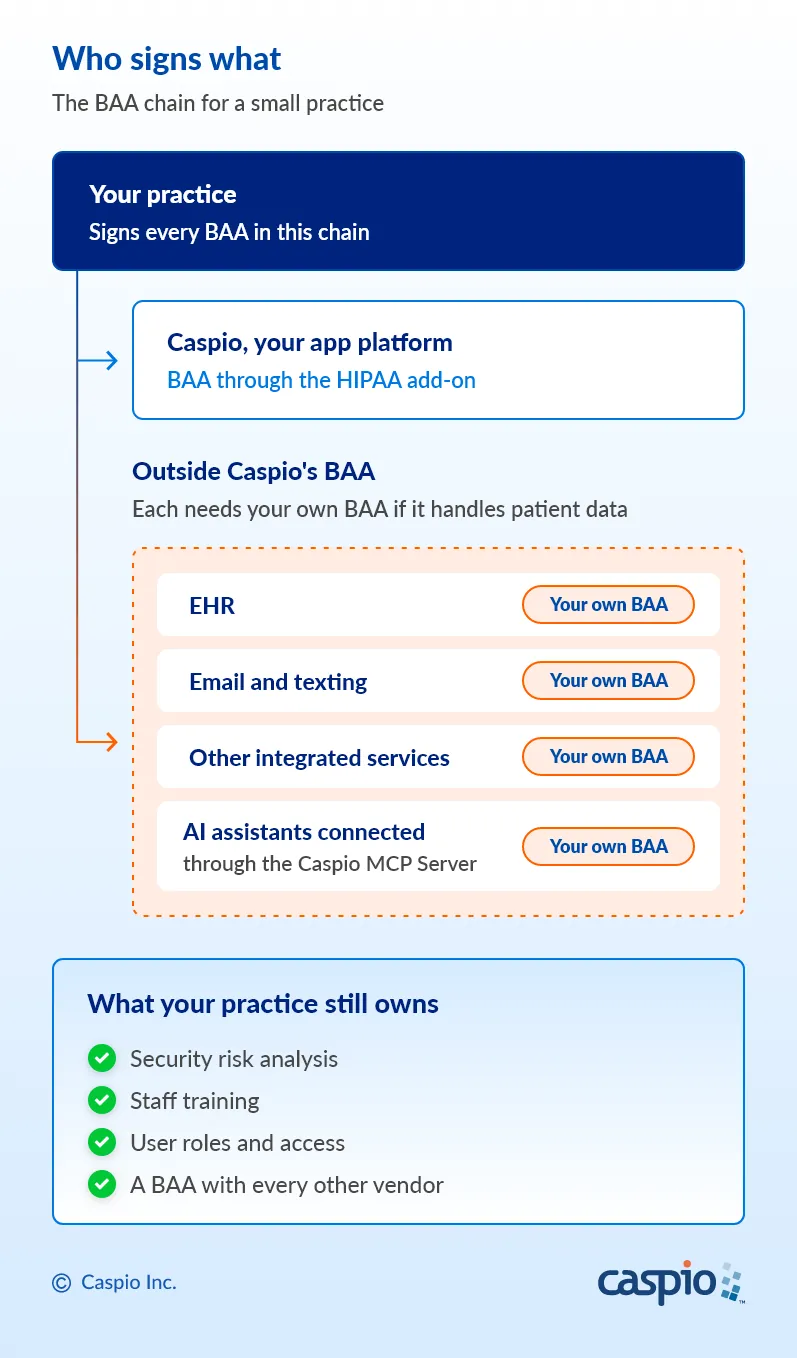
WHO SIGNS WHAT: Caspio signs a BAA with your practice through the HIPAA add-on. Each additional vendor handling patient data needs a separate BAA with your practice, based on 45 CFR 164.502(e) and 164.308(b)(1).
The takeaway: a signed BAA is one part of compliance, not a substitute for the safeguards your practice manages. Use the checklist above to review your vendor agreements, access controls, staff training, and security risk analysis before putting patient data into a new app. This is a practical starting point, not legal advice; review questions about your practice’s specific obligations with a qualified legal or compliance adviser.
How to Choose an App Builder for a Small Practice
The right app builder should fit both your practice’s compliance needs and the realities of a busy front desk. Weigh the six criteria below in order, starting with a signed BAA on a plan you can afford. Then compare setup, ongoing maintenance, support, and patient access to find a platform your team can manage day to day.
- Signed BAA on the plan you would actually buy (must-have): The vendor signs before patient data enters, on a tier your budget allows.
- Total monthly cost including HIPAA, published (high): The full price with HIPAA appears on the vendor’s pricing page.
- Setup time (high): Templates and AI-assisted building put a working app in front of staff quickly.
- No-IT maintenance (high): The vendor hosts and updates the platform, and an independent party certifies it every year.
- Human support hours (high): A person answers when an app breaks before morning clinic.
- Patient-facing apps and staff growth (medium): Patients can use the apps, and a new hire does not add a per-user fee.
Running several departments or sites? See our guide to the best HIPAA-compliant app builders.
The Best App Builders for Small Medical Practices
The five platforms below are organized by the practice situation each fits. Each platform was checked against its vendor’s pricing, HIPAA, and support pages in October 2026.
Caspio
Caspio is an AI platform for building custom business applications, and it pairs AI-assisted building with HIPAA, SOC 2 Type II, and GDPR compliance, independently certified annually. Practices use it for the healthcare applications that run around the EHR.
Best for: Practices that need patient-facing apps on certified infrastructure, with a person on support at any hour.
- AI that builds and serves: Describe the app and Caspi builds it, including the data model, interface, and roles. The Chat AI Agent answers signed-in users’ questions about app data within their existing permissions, and AI Connector Extensions add OpenAI GPT, Google Gemini, and Anthropic Claude, with more on the way.
- Patients and staff: Hosted apps or embeddable apps and components on your practice website, role-based access and record level security, and unlimited app users with no per-user fees. Start with the free Patient Portal starter app, or browse more healthcare-related app templates in the Caspio Marketplace.
- Scheduling: Caspio’s Calendar component shows appointments, shifts, and events in day, week, month, and schedule views, and staff with the right role can add, move, and resize them. Pair it with a patient-facing request form and the front desk confirms the slot.
- Integrations: Connect Caspio to other systems through built-in integrations, including REST API, webhooks, Zapier, Make, n8n, and Keragon.
- Support and services: Get 24/7 live chat support from a real person on every plan. If you need help building your app, our team or one of our certified partners can do it for you.
- Pricing: Starting from $300/month; HIPAA is a $500/month add-on on top of your plan rate (one-year term), so Caspio is HIPAA-enabled from $800/month total (TEAM + add-on). The 14-day free trial cannot hold real patient data: build and test with sample data, then add real patient data on a paid plan once the HIPAA add-on is active and the BAA is signed.
Where it falls short for a small practice: It does not have the lowest entry HIPAA price on this list. The section after this roundup explains when another tool costs less.
Knack Health
Knack Health includes a signed BAA on its HIPAA plans, and its entry HIPAA plan is priced below Caspio’s HIPAA-enabled total.
Best for: Practices that want a few internal and patient-facing apps at the lowest published entry HIPAA price.
Where it falls short: Self-service patient booking and payments sit on the custom-priced HIPAA Core tier, standard support runs weekdays from 8 a.m. to 8 p.m. ET, and it publishes no annual HIPAA or GDPR certification. No built-in AI chat agent for people using a Knack app was found (October 2026).
Jotform
Jotform provides a signed BAA once HIPAA features are enabled on its Gold or Enterprise plans, and it offers 24/7 customer support.
Best for: Intake forms, consent, and simple appointment requests.
Where it falls short: Gold is a single-user plan, and Jotform builds forms, not full applications with roles and records, so referral tracking and follow-up queues usually need another tool.
Google AppSheet
Administrators can accept Google’s BAA through AppSheet sales before any patient data is used.
Best for: A handful of staff building internal apps inside Google Workspace.
Where it falls short: Pricing is per user, so signed-in patients add licenses, and the public no-sign-in tier cannot hold sensitive data. HIPAA setup is customer-managed: patient data stays out of app definitions, and the practice marks HIPAA data as sensitive.
Blaze
Blaze signs a BAA on its entry paid plan and offers implementation services.
Best for: Practices that want the vendor’s team to build the app.
Where it falls short: The entry plan is limited to one published app and 100 end users. All paid plans also require a one-time implementation fee.
When Caspio Is Not the Cheapest Fit
Knack Health, Blaze, and Jotform each publish entry HIPAA prices below Caspio’s HIPAA-enabled total. If you need forms and nothing more, a forms tool’s HIPAA tier costs less. If a few staff need internal apps inside Google Workspace, AppSheet costs less. If the goal is a few apps at the lowest published entry HIPAA price, Knack Health costs less.
Caspio is worth the investment when your practice needs patient-facing apps backed by independently certified compliance controls, 24/7 human support, or a Chat AI Agent for app users. Prefer to leave the building to someone else? Our Professional Services team or a Caspio-certified partner can build the app for you.
Small practices are the focus here, not the limit: as an AI application platform trusted by thousands of organizations worldwide, Caspio delivers a compliant app in a compliant environment for any organization that values security, reliability, and scalability.
Small Practice App Builder Comparison
The table compares Caspio with three platforms small practices shortlist on BAA, certification, support, patient-facing apps, and AI.
| Feature | Caspio | Knack Health | Jotform | Google AppSheet |
|---|---|---|---|---|
| Signed BAA on the entry HIPAA plan | Yes, through the HIPAA add-on on any published plan, including TEAM | Yes, included with Knack Health HIPAA plans | Yes, on Gold and Enterprise once HIPAA features are enabled | Yes, administrator accepts Google’s BAA through AppSheet sales |
| Annual independent certification (HIPAA, SOC 2 Type II, GDPR) | Yes, all three independently certified annually | Annual SOC 2 Type II audit, report under NDA; no published annual HIPAA or GDPR certification | HIPAA and GDPR compliance stated; SOC 2 stated for the Jotform Sign product; no published annual independent certification of all three | HIPAA coverage through Google’s BAA; no AppSheet-specific annual HIPAA or GDPR certification published |
| Human support hours | 24/7 live chat on every plan | Weekdays 8 AM to 8 PM ET; 24/7 emergency support on Plus and Enterprise plans | 24/7 customer support | 24/7 email and chat support per the AppSheet team; priority support on Enterprise Plus |
| Patient-facing apps | Yes, hosted apps or embeddable apps and components with role-based access and record level security | Yes, Live Apps with embed code | Patient-facing forms, not full applications | Signed-in patients need per-user licenses; the public tier excludes sensitive data and sign-in |
| AI capabilities | Caspi builds the app you describe; Chat AI Agent for signed-in users; AI Connector Extensions (OpenAI GPT, Google Gemini, Anthropic Claude); Caspio MCP Server | AI app builder, MCP server, and LLM connectors; no built-in end-user AI chat agent found (October 2026) | AI Agents (Gemini via Vertex AI on HIPAA accounts) | AI-assisted app creation for paid Workspace users; advanced AI on Enterprise Plus |
Where Caspio leads in this table. All four sign a BAA. Of the platforms compared here, Caspio is the one that publishes annual independent certification of HIPAA, SOC 2 Type II, and GDPR. Its 24/7 live chat ties the around-the-clock support Jotform and AppSheet describe and runs longer than Knack Health’s weekday standard support. Caspio and Knack Health both deliver full patient-facing apps, where Jotform builds forms and AppSheet licenses each signed-in patient. Caspio’s Chat AI Agent answers app users’ questions about their data; Knack Health’s published features do not list an equivalent.
Knack Health fits practices whose apps stay inside its plan limits and business-hours support. Jotform fits practices that mainly need forms. AppSheet fits a few staff working inside Google Workspace.
Frequently Asked Questions
What is the best app builder for a small medical practice?
The best app builder for a small medical practice depends on the apps you need, and Caspio fits practices that need patient-facing apps, annual independent certification, and 24/7 human support. A forms tool or Google AppSheet can cost less for forms or a few internal staff apps. Caspio signs a BAA through its HIPAA add-on, and its HIPAA, SOC 2 Type II, and GDPR controls are independently certified annually.
Do I need IT staff to build apps for my practice?
No, a small practice does not need IT staff when the app builder hosts, updates, and secures the platform for it. On Caspio, an office manager can describe an app and Caspi builds the data model, interface, and roles. If you want help, you can have us or one of our many certified partners build it for you.
Who signs the BAA when a small practice uses an app builder?
The app builder vendor signs a BAA with the practice before patient data enters the platform, and on Caspio, that BAA comes through the HIPAA Edition. The practice still owns its security risk analysis, user access, staff training, and a BAA with every other vendor that handles patient data.
How much does an app builder cost for a small medical practice?
An app builder for a small medical practice costs its plan rate plus any HIPAA charge, so compare total monthly cost including HIPAA. Caspio is priced starting from $300/month, and HIPAA is a $500/month add-on on top of your plan rate (one-year term), so Caspio is HIPAA-enabled from $800/month total (TEAM + add-on). A 14-day free trial lets you build with sample data, and real patient data waits for a paid plan with the HIPAA add-on active and the BAA signed.
What apps should a small medical practice build first?
Start with the app that replaces your most painful paper process, usually patient intake and consent, then add appointment scheduling, referral tracking, follow-up lists, and staff checklists. Each one fills a gap around your EHR rather than replacing it. On Caspio, the free Patient Portal starter app gives you a ready starting point.
Start With One App for Your Practice
A small practice needs intake that writes to one database, referrals that do not slip, and a checklist the morning staff actually use, under a signed BAA. If you would rather not build it yourself, talk to our team and have us or one of our many certified partners build it for you.
Start a 14-day free trial and build your first practice app with sample data today.

Recommended Articles

Best Knack Alternatives (2026): AI and Compliance
READ STORY
Secure AI Code Generation: 10-Point Checklist
READ STORY
Best Bubble Alternatives for Business Apps (2026)
READ STORY
How to Build Internal Apps With AI in 2026: 6 Steps
READ STORY
Best Bolt.new Alternatives for Business Apps (2026)
READ STORY
Online Database With a SQL Backend: 7 Questions to Ask
READ STORY
9 Vibe Coding Security Risks in AI-Generated Apps
READ STORY
Build Custom Business Apps Easily: 3 Patterns
READ STORY
Caspio AI Connector Extensions: 5 Jobs for Your Tables
READ STORY
PHI and Caspio AI: Which Features Your BAA Covers
READ STORY
How AI Agents Buy Software, and Why Legibility Wins
READ STORY
10 Questions to Ask Before Connecting AI to Business Data
READ STORY
