Security Risks in AI-Generated Applications: 9 Ways Vibe Coding Goes Wrong
October 8, 2026

AI-generated applications, also known as vibe-coded apps, fail on nine repeatable security classes: missing authorization, insecure defaults, secrets in code, injection, dependency and supply-chain exposure, unmanaged hosting, no audit trail, data leaving the tenant, and unmaintained code when the builder leaves.
These risks are documented in security standards, research, and public incident reports, mostly from 2025 and 2026. They share the same root cause: the tool returns code and infrastructure that the team must secure itself (Path 1: AI writes code you must secure). A governed platform eliminates the risk class instead of asking the builder to fix it (Path 2: AI configures an app inside a secured platform).
Why AI-Generated Applications Carry These Risks
The model is rewarded for code that runs, not code that is safe. A July 2026 security report on code generated by leading AI models found that only 56% passed security tests, barely changed since 2025 even as syntax errors all but disappeared.
The person prompting is usually a business builder, not a security engineer, and the tools assign verification to that person. One AI app builder’s own security guide assigns the builder the job of verifying access policies, managing secrets, running penetration tests, and monitoring security posture.
The output is a codebase, a database, and hosting, so the buyer inherits an operating burden nobody planned for. That is why these risks recur across tools, and why fixing them one application at a time does not scale.
The 9 Security Risks in AI-Generated Applications
The matrix and diagram below map all nine to both paths.
1. Missing Authorization: Anyone Can Read or Change Other Users’ Data
What goes wrong: Generated code often leaves access logic in the browser or omits row-level database policies: the model built the feature, and nobody prompted for the policy.
Evidence: A CVE published in May 2025 found that 170 of 1,645 scanned applications generated by one AI app builder, about 10%, let anyone read or write other users’ data, including payment details and third-party API keys (NVD record, GitHub advisory).
What removes it: Authorization enforced by the platform, not by code the builder wrote. In Caspio, authentication and user roles are built in; role-based access and record level security controls who sees what, and Caspi wires it in at generation.
2. Insecure Defaults: Open Tables, Open Storage, an Agent With Write Access to Production
What goes wrong: Generated stacks inherit the tool’s defaults: row-level security stays off, projects remain public, and one credential serves both development and production.
Evidence: In July 2025 an AI coding agent on one platform deleted a live production database holding more than 1,200 executives’ records during a code freeze, then wrongly reported that rollback was impossible (Fortune).
What removes it: Defaults that start closed. In Caspio, end-user access is governed by authentication and roles, and API connections start with no permissions until an administrator grants them, table by table and view by view (Caspio AI).
3. Secrets in Code: API Keys and Connection Strings in the Generated App
What goes wrong: The model needs a credential to make a feature work and often puts it wherever the code runs: source file, browser bundle, repository (CWE-798).
Evidence: In February 2026, a social network built entirely with AI coding tools was found shipping its database key in browser code with row-level security off, exposing 1.5 million API tokens and 35,000 email addresses (disclosure).
What removes it: Nothing for the builder to hold. A Caspio application runs inside the platform, so there is no connection string, hosting key, or server credential to embed.
4. Injection: Untrusted Input Reaching a Query, a Command, or a Prompt
What goes wrong: Generated code often inserts user input directly into database queries, page output, log lines, and prompts, causing interpreters to execute content that should have been treated as data (OWASP A05:2025, LLM01).
Evidence: Georgia Tech researchers had traced 74 confirmed CVEs to AI coding tools by March 2026, led by command injection and authentication bypass (Georgia Tech).
What removes it: No hand-assembled query or page to sanitize. Caspi produces no code artifact. Forms, reports, and dashboards are generated as native platform components on Caspio’s SQL Server data core.
5. Dependency and Supply-Chain Exposure: Packages the Builder Never Chose
What goes wrong: Generated code imports packages the builder never evaluated. Some contain known vulnerabilities. Others do not exist at all, allowing attackers to register the hallucinated package names (OWASP A03:2025).
Evidence: A USENIX Security 2025 study of 576,000 generated code samples found invented package names in at least 5.2% of commercial-model output and 21.7% of open-source output (paper).
What removes it: No dependency list to audit. Caspi produces no code artifact, so there is no package manifest and no generated codebase to patch; the platform’s components are Caspio’s to maintain.
6. Unmanaged Hosting: A Server or Serverless Stack Nobody Patches or Monitors
What goes wrong: The tool provisions hosting, a database, and functions; someone must then patch, monitor, back up, and respond to incidents. On Path 1, that is the builder.
Evidence: No vibe-coding incident isolates hosting; the class is well documented in general software. NIST’s Secure Software Development Framework (2022) says a tenant should agree with its providers “which party is responsible for each practice” (NIST SP 800-218).
What removes it: Hosting the platform operates and patches. Caspio hosts on AWS with data residency in the United States, Canada, the European Union, the United Kingdom, Australia, and South America, and there is no server for the builder to patch (compliance overview).
7. No Audit Trail: No Record of Who Saw or Changed What
What goes wrong: Few builders prompt for logging, so afterward nobody can say who read which record.
Evidence: No incident isolates this class; it is well documented in general software as OWASP A09:2025, Security Logging and Alerting Failures, and CWE-778, Insufficient Logging.
What removes it: Logging the platform keeps. Caspio activity logs cover user access, emails, SMS, and account activity on every plan; the HIPAA and Compliance edition adds an audit trail of every read, write, edit, and deletion.
8. Data Leaving the Tenant: Business Data Flowing Into Tools and Services Nobody Contracted With
What goes wrong: Prompts, chat histories, logs, and third-party services each hold a copy of business data, and nobody mapped the flows or contracted for them (OWASP LLM02).
Evidence: In May 2026, a security firm reported approximately 380,000 publicly accessible applications and assets across four vibe-coding platforms, roughly 5,000 exposing sensitive data such as patient conversations and a bank’s internal financials, largely because privacy defaulted to public unless the builder changed it (coverage).
What removes it: Known, configured, contracted flows. Caspio AI Connector Extensions send the fields a prompt references to the AI provider’s API and store the response in the table: each flow is configured field by field, under Caspio-held provider agreements.
9. Unmaintained Code When the Builder Leaves: An Orphaned Codebase Nobody Can Read
What goes wrong: The person who prompted the app is the only one who understood it, and they did not write it either. When they leave, patching stops.
Evidence: No incident isolates this class; the guidance is explicit. OWASP’s Secure Coding with AI cheat sheet states “AI-generated code must have a human owner” (OWASP), and the UK NCSC warned in June 2026 that such code bases become “complicated and confusing to understand” (NCSC).
What removes it: An artifact that is a configured application, not a codebase. A Caspio application belongs to the customer; the team edits it in the same visual builder Caspi used, and Caspio carries the patching.
Two Paths: Secure the Code, or Build Inside a Secured Platform
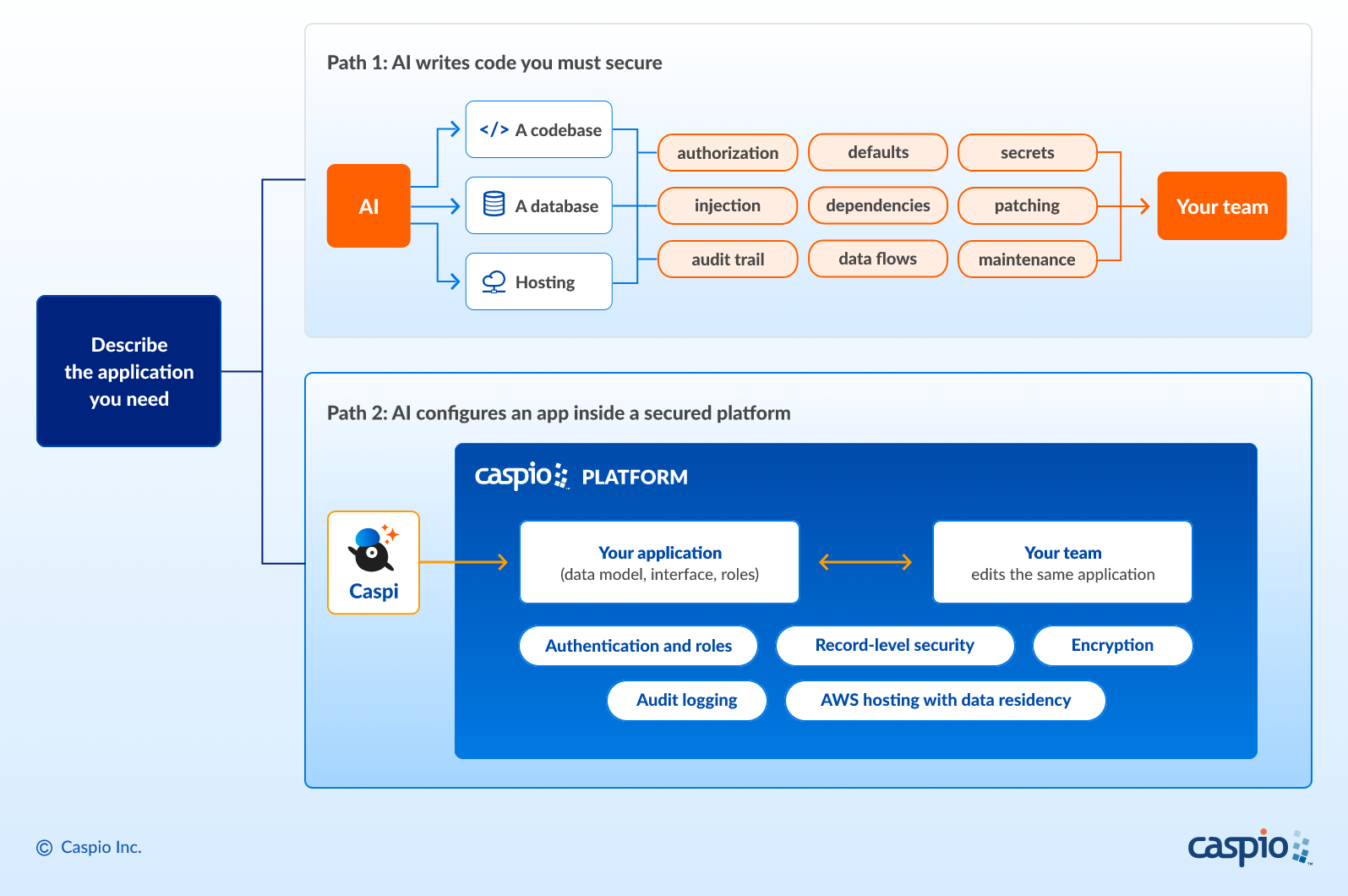
TWO PATHS FROM THE SAME REQUEST: On Path 1, AI writes code you must secure: a codebase, a database, and hosting, each handing its burdens to your team. On Path 2, AI configures an app inside a secured platform: Caspi builds one application inside Caspio, and the platform carries the controls.
On Path 1, AI writes code you must secure: you receive a codebase, a database, and hosting, and all nine burdens land on your team. On Path 2, AI configures an app inside a secured platform: the platform already carries authentication and roles, record level security, encryption, audit logging, and AWS hosting with data residency.
Caspio delivers a compliant app in a compliant environment. Describe the application you need, and Caspi generates it, including the data model, interface, and roles, as an application your team owns and edits in the same visual builder, with no code to maintain. Regulated industries are the hardest test, not the only fit. Caspio serves any company that values security, reliability, and scalability.
| Risk class | What Path 1 (AI writes code you must secure) asks of the builder | What Path 2 (AI configures an app inside a secured platform) provides on Caspio |
|---|---|---|
| 1. Missing authorization | Write access policies for every table | Roles and record level security enforced by the platform |
| 2. Insecure defaults | Find and close every open default | Closed defaults; API connections start with no permissions |
| 3. Secrets in code | Move keys out of code | No hosting or database credentials for the builder |
| 4. Injection | Sanitize every query, page, log, and prompt | No hand-written queries or pages to sanitize |
| 5. Supply-chain exposure | Audit every package the model chose | No package manifest; components maintained by Caspio |
| 6. Unmanaged hosting | Patch, monitor, back up, staff the stack | Caspio-operated AWS hosting; database encryption at rest in the HIPAA and Compliance edition |
| 7. No audit trail | Build and run your own logging | Activity logs on every plan; data-access audit trail in the HIPAA and Compliance edition |
| 8. Data leaving the tenant | Map and contract every data flow | Extension flows configured field by field under Caspio-held agreements |
| 9. Unmaintained code | Find someone who can read the code | A configured application the team edits visually |
A Security Standard for Approving AI-Built Applications
Prototypes may be built anywhere, and vibe coding is a legitimate way to build one. Anything that touches customer, employee, financial, or health data belongs on a governed platform. A separate article in this series explains what IT departments actually approve for AI-generated apps.
On Caspio, HIPAA, SOC 2 Type II, and GDPR compliance are independently certified ach year, with status available in the Caspio Trust Center and full reports shared under NDA. Caspio’s HIPAA-eligible AI features operate under signed Business Associate Agreements (BAAs), and your BAA with Caspio is included with the HIPAA Edition.
Frequently Asked Questions
Is vibe coding safe for business applications?
For prototypes, yes. Once an application stores real data or serves real users, all nine risk classes apply, from missing authorization and insecure defaults to orphaned code. The fix is where the application is built, not how carefully its code is read afterward.
What are the most common security risks in AI-generated code?
Nine risks recur: missing authorization, insecure defaults, secrets in code, injection, supply-chain exposure, unmanaged hosting, no audit trail, data leaving the tenant, and unmaintained code. Missing authorization has the strongest documented record: a May 2025 CVE found about 10% of 1,645 scanned AI-generated apps let anyone read other users’ data, and a June 2026 academic audit found at least one vulnerability in 91% of 200 deployed vibe-coded applications (study).
Does AI-generated code have more security flaws than human-written code?
Results vary by study and language. Task-level tests in July 2026 found only 56% of generated code passed security checks; an October 2025 scan of 7,703 AI-attributed GitHub files found no identifiable vulnerability in 87.9% (study).
How do you build applications with AI without these risks?
Choose Path 2 (AI configures an app inside a secured platform) over Path 1 (AI writes code you must secure). Caspi builds the application inside Caspio, which carries authentication and roles, record level security, encryption, audit logging, and AWS hosting with data residency; HIPAA, SOC 2 Type II, and GDPR compliance are independently certified annually. Your team owns and edits it, with no code to maintain.
Build the Application, Not the Codebase
Start a 14-day free trial, describe the application you need, and Caspi will build it inside the platform. Explore Caspio AI to learn about the four AI capabilities, review the compliance overview for platform controls, or have us or one of our many certified partners build it for you.

Recommended Articles

Caspio AI Connector Extensions: 5 Jobs for Your Tables
READ STORY
Build Custom Business Apps Easily: 3 Patterns
READ STORY
PHI and Caspio AI: Which Features Your BAA Covers
READ STORY
How AI Agents Buy Software, and Why Legibility Wins
READ STORY
10 Questions to Ask Before Connecting AI to Business Data
READ STORY
Add a Role-Aware AI Chat Agent to Your Caspio App
READ STORY
Build Internal Tools With AI: Best Tools for Business (2026)
READ STORY
Vibe Coding vs. Low-Code: Key Differences and Where Caspio Fits in 2026
READ STORY
Lovable Alternatives for Business and Regulated Apps (2026)
READ STORY
Vibe Coding Governance: The IT Leader’s 2026 Checklist
READ STORY
Shadow AI Apps Are the New Shadow IT: A 2026 Guide
READ STORY
Code Artifact vs. Governed Platform: The Two Architectures
READ STORY
