Best Healthcare App Builder: How the Top Platforms Compare in 2026
November 6, 2026
A healthcare app builder is a platform that lets healthcare teams build secure applications such as patient portals, intake forms, scheduling, and care-coordination tools without a traditional development project. The best healthcare app builder pairs a signed Business Associate Agreement (BAA) and annual independent certification with real application depth and pricing that does not penalize you for adding patients.
Best for: Clinics and practice groups, health system departments, telehealth and home health providers, payers and labs, public health agencies, health nonprofits, and the consultancies that build for them.
Most healthcare app builders focus on just one area. Some handle forms, others support internal workflows, and some offer HIPAA compliance but little beyond that. Yet healthcare organizations need all these capabilities working together, from staff workflows and patient-facing portals to partner access and proof that the platform protecting their data undergoes independent certification every year.
This guide sets out eight criteria for choosing a healthcare app development platform, applies them to six platforms healthcare teams shortlist most often, and shows where each one fits and why Caspio leads for most teams.
What Is a Healthcare App Builder?
A healthcare app builder, sometimes called a medical app builder, is a platform for creating custom healthcare workflow apps on a secure database and deploying them to staff, patients, and partners. The strongest platforms cover the whole application, not one slice of it:
- Secure database: Patient, visit, and operational records in one governed data layer instead of scattered spreadsheets.
- Forms and intake: Registration, consent, and screening forms that write directly to that database.
- Patient-facing portals: Secure logins where patients view visit history, update profiles, and message staff.
- Scheduling: Appointment and resource calendars that staff and patients both use.
- Workflow automation: Routing, notifications, and task handoffs between teams.
- Reporting and dashboards: Operational metrics generated from live data, not compiled by hand.
- Clinical-system integrations: Connections to EHRs, labs, and billing tools through APIs and healthcare integration platforms.
- Role-based access and record level security: Every user sees only the records their role permits.
- AI-assisted building: Describe an application in plain language and get a working starting point.
Who uses it? Operations directors and practice administrators oversee application development and daily workflows, IT leaders manage the technology and budget, and compliance officers ensure patient data is handled securely and regulatory requirements are met.
Where Healthcare App Builders Fall Short
Most platforms on a typical shortlist fail healthcare teams in one of four predictable ways:
- Forms-only tools stop at intake. A HIPAA form from a tool like Jotform captures data. It does not run the scheduling, follow-up, case management, and reporting that happen after a patient clicks submit.
- Per-user pricing breaks at patient scale. Google AppSheet, Zoho Creator, Retool, and Claris FileMaker all price per user, and Retool splits seats into builder, internal, and external types. Every patient, caregiver, and referring partner who needs a login becomes another line item.
- “HIPAA-ready” is not a signed BAA plus annual independent certification. Bubble’s own manual states that its platform currently does not meet HIPAA standards. Claris states that it does not claim HIPAA compliance and prohibits protected health information on FileMaker Cloud. Before any platform reaches your shortlist, confirm in writing that the vendor signs a BAA and that an independent party certifies its controls every year. Learn more about reading compliance claims.
- Entry-tier limits surface after you commit. Blaze’s entry BAA plan allows one published app and up to 100 end users, and Knack Health reserves native appointment booking and payments for its custom-priced HIPAA Core tier.
The fix is not a longer feature list. It is a clear set of criteria, applied before the demo rather than after the contract. We checked every platform below against its vendor’s own pricing, security, and HIPAA pages in October 2026.
8 Criteria: How to Evaluate a Healthcare App Builder
Whether you need an app builder for clinics or for a health system department, judge every healthcare app builder against eight criteria, in this order:
- Signed BAA: The vendor signs a BAA before any protected health information enters the platform.
- Annual independent certification: HIPAA, SOC 2 Type II, and GDPR controls are certified by an independent party every year, not self-asserted.
- Application depth beyond forms: One platform covers the database, workflows, portals, scheduling, and reporting.
- Hosted or embeddable patient-facing apps: A true patient portal builder lets you fully host or embed secure apps on the website patients already use.
- Record level security and SSO: Access rules reach individual records, with single sign-on for staff.
- Clinical-system integrations: APIs, webhooks, and healthcare integration platforms connect your apps to the systems you already run.
- Pricing that scales to patients and partners: Adding patients, caregivers, and partners does not add per-user fees.
- Governed AI and 24/7 human support: AI respects your security model, and a person answers at any hour.
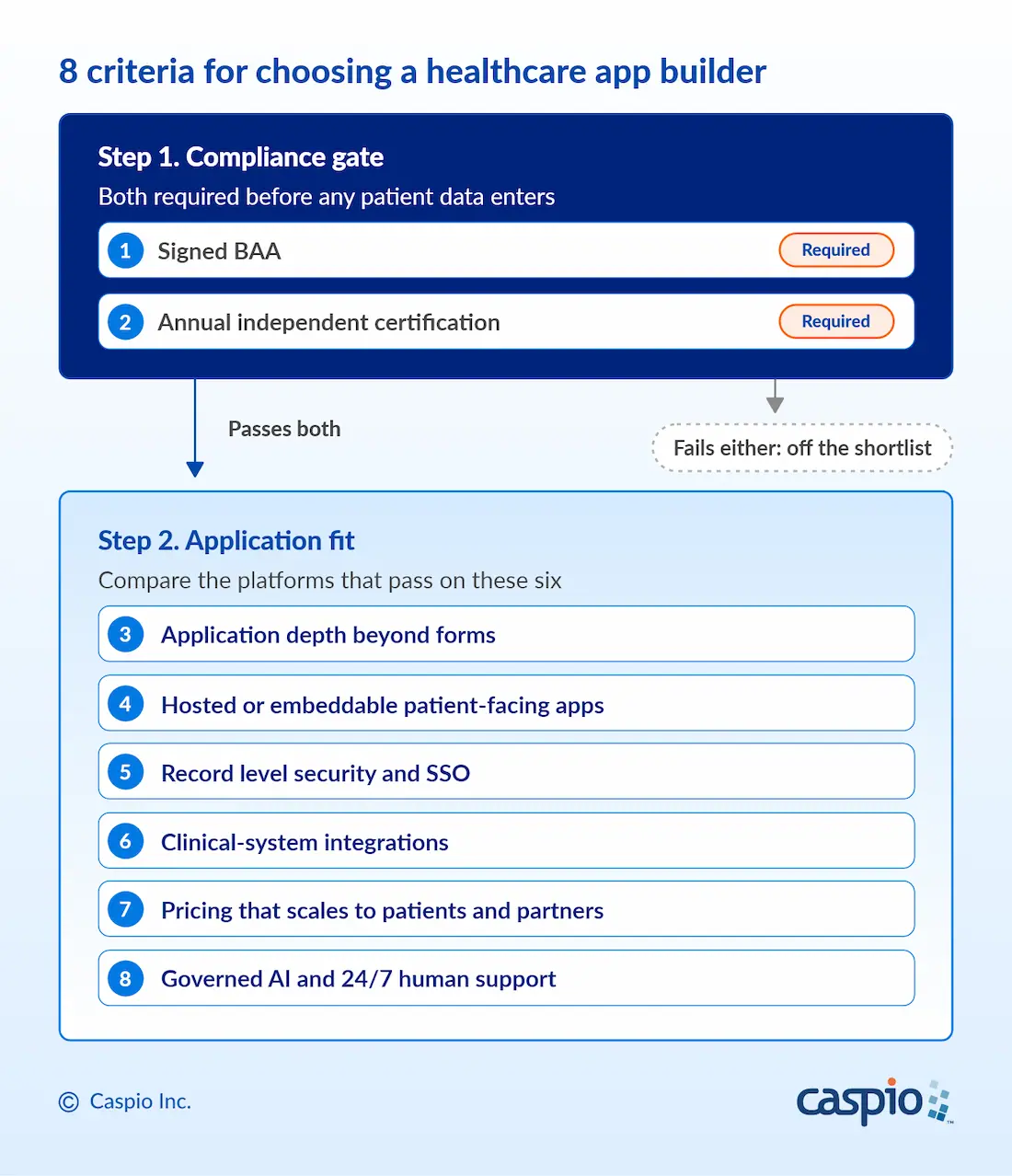
Use the first two criteria as a pass/fail gate before any patient data enters a platform, then compare the platforms that pass on the remaining six.
Compliance is the gate, not the whole decision. For a compliance-first deep dive on BAAs, infrastructure, and audits, see how to evaluate HIPAA-compliant app builders.
The Best Healthcare App Builders in 2026
Applied to these eight criteria, Caspio is the best healthcare app builder for most teams. The six platforms below are ordered by healthcare fit.
Caspio
Caspio is an AI platform for building custom business applications, and it leads this list because AI and compliance come together on one platform. Healthcare teams use it to build healthcare applications for staff, patients, and partners, backed by more than two decades of platform engineering.
Best for: Healthcare organizations that need full applications, patient-facing portals, and certified compliance on one platform.
- Annual independent certification: HIPAA, SOC 2 Type II, and GDPR are independently certified annually. Caspio signs a BAA through the HIPAA Edition, and you build HIPAA-compliant applications on a certified platform.
- Flexible deployment: Deploy fully hosted apps, or embed portals, intake forms, and dashboards on your existing website. Start with the free Patient Portal app template.
- Unlimited users: Every plan includes unlimited users with no per-user fees.
- Record level security and SSO: Role-based access and record level security, SAML SSO on select plans, and Identity Management that also serves as an identity provider for third-party apps.
- Scheduling and intake: An interactive calendar component shows records as events with role-based permissions, and file uploads on forms can trigger bulk data imports.
- Integrations: Connect your app to third-party systems through integration options such as REST API, webhooks, Zapier, Make, n8n, and Keragon, a HIPAA-compliant automation platform for healthcare integrations.
- Governed AI: Caspio’s AI capabilities work inside your security model:
- Caspi builds the application you describe, including the data model, interface, and roles.
- The Chat AI Agent answers signed-in users’ questions about app data within their existing permissions.
- AI Connector Extensions add OpenAI GPT, Google Gemini, and Anthropic Claude, with more on the way. Caspio’s HIPAA-eligible AI features operate under signed BAAs. Caspio holds signed BAAs with the providers behind all three extensions.
- The Caspio MCP Server connects Caspio data to MCP-compatible AI assistants; third-party assistants handling PHI require your own BAA with each provider.
- 24/7 human support and Professional Services: 24/7 live chat on every plan, and you can have us or one of our many certified partners build it for you.
- Pricing: Starting at $300/month. HIPAA is a $500/month add-on on top of your plan rate (one-year term), so Caspio is HIPAA-enabled from $800/month total. AI capabilities are available on every plan tier, and a 14-day free trial is available.
Healthcare is the emphasis, not the limit. As an AI application platform trusted by thousands of organizations worldwide, Caspio delivers a compliant app in a compliant environment for any organization that values security, reliability, and scalability.
Knack (Knack Health)
Knack sells a separate healthcare line, Knack Health, with a BAA included on its HIPAA plans.
Best for: Small healthcare teams whose needs fit a few apps and modest record volumes.
Where it falls short for healthcare: The HIPAA Starter tier is limited to three apps, 10,000 records, and Google SSO only, and native appointment booking and payments are reserved for the custom-priced HIPAA Core tier. Knack offers a SOC 2 Type II report under NDA, publishes no annual HIPAA or GDPR certification, and its standard support hours are weekdays from 8 AM to 8 PM ET.
Blaze
Blaze targets healthcare directly, lists patient portals, scheduling, and telehealth among its use cases, and signs a BAA on its entry paid plan. Its implementation services build your app from start to finish.
Best for: Teams that want a vendor to build a small number of apps for them.
Where it falls short for healthcare: That entry plan covers one published app and up to 100 end users, the next tier caps at five apps and 1,000 users, and paid plans carry a one-time implementation fee. Patient-facing programs outgrow those caps quickly.
Google AppSheet
AppSheet Core is included in most paid Google Workspace plans, and administrators can accept a BAA before protected health information is used.
Best for: Google Workspace organizations building internal staff apps.
Where it falls short for healthcare: Pricing is per user, and the per-app public tier only supports apps that do not contain sensitive data or require sign-in, which rules it out for patient portals. HIPAA setup is customer-managed: Google requires customers to keep PHI out of app definitions and mark HIPAA data as sensitive. Starter and Core plans include email support.
Zoho Creator
Zoho Creator offers HIPAA features on paid plans and provides a BAA template on request by email.
Best for: organizations already standardized on the Zoho suite.
Where it falls short for healthcare: Pricing is per user, the Standard plan is capped at one application, and external users require a separately priced Customer Portal add-on. SAML SSO is an add-on on two of its three paid plans, 24/7 support is a paid add-on, and Zoho’s HIPAA guide makes the covered entity responsible for protecting exported audit trails.
Jotform
Jotform is a forms product with HIPAA features on its Gold and Enterprise plans.
Best for: HIPAA intake and consent forms that feed another system.
Where it falls short for healthcare: Gold is a single-user plan with 10,000 monthly submissions, and Enterprise is custom-priced. Its HIPAA tiers are form plans, so teams that need full applications behind intake still need another platform. Its HIPAA pricing page does not mention SOC 2 or a HIPAA audit.
Healthcare App Builder in Action: How Paragon Global CRS Cut Data Entry by 80%
Paragon Global CRS, a clinical research support company in Wilmington, North Carolina, provides concierge services for clinical-trial patients.

Problem
Patient requests arrived around the clock, data entry kept growing, and every workflow had to meet HIPAA requirements. Off-the-shelf healthcare software did not fit how Paragon worked.
Solution
Paragon built an online patient portal and an internal admin application on Caspio, launching the first version in five months. “What we’ve been able to do with Caspio is turn a business problem into an opportunity for growth,” said Danielle Baxter, Director of Business Development.
Result
The application reduced Paragon’s data entry time by 80%, and reports that once took two weeks now generate in seconds. Read the full Paragon Global CRS story.
Healthcare App Builder Comparison
The table compares Caspio with four shortlisted platforms on the criteria that separate a healthcare application platform from a general tool.
| Feature | Caspio | Knack | Google AppSheet | Zoho Creator | Jotform |
|---|---|---|---|---|---|
| Signed BAA | Yes, through the HIPAA add-on on every published plan | Yes, on Knack Health HIPAA plans | Yes, accepted by your administrator | Yes, BAA template by email request; HIPAA features on paid plans only | Yes, on Gold and Enterprise plans with HIPAA features enabled |
| Annual independent certification (HIPAA, SOC 2 Type II, GDPR) | Yes, all three independently certified annually | SOC 2 Type II report under NDA; no published annual HIPAA or GDPR certification | HIPAA coverage through Google’s BAA; no AppSheet-specific annual HIPAA or GDPR certification published | SOC 2 Type II and a SOC 2 + HIPAA report; GDPR compliance self-described | Not published on its HIPAA pricing page |
| Hosted or embeddable patient-facing apps | Yes, hosted apps or embeddable apps and components | Yes, on HIPAA Starter and HIPAA Core plans | Signed-in patients need per-user licenses; the public-app tier excludes sensitive data and sign-in | Through a separately priced Customer Portal add-on | Forms, not full applications |
| 24/7 human support | Yes, 24/7 live chat on every plan | Standard support weekdays, 8 AM to 8 PM ET | Email support; priority support on Enterprise Plus | 24/7 support is a paid add-on | 24/7 customer support on Gold |
| AI capabilities | Caspi (full app generation), Chat AI Agent, AI Connector Extensions (OpenAI GPT, Google Gemini, Anthropic Claude), Caspio MCP Server | AI app builder and MCP server on HIPAA plans | AI app creation for paid Workspace users; advanced AI on Enterprise Plus | CoCreator prompt-to-app and custom AI models | AI Agents, using Google Gemini via Vertex AI on HIPAA accounts |
Where Caspio wins. Caspio is the only platform in this comparison that publishes annual independent certification of HIPAA, SOC 2 Type II, and GDPR, and it pairs that proof with unlimited users, hosted or embeddable patient-facing apps, 24/7 human support, and governed AI on one platform. That combination is what makes it the best healthcare app builder for teams serving staff, patients, and partners at once.
Knack fits small teams whose needs stay inside its entry HIPAA tier. Google AppSheet fits internal staff apps inside Google Workspace. Zoho Creator fits organizations already running the Zoho suite. Jotform fits intake forms that feed another system. Blaze fits vendor-built programs that stay within its user caps.
Frequently Asked Questions
What is the best healthcare app builder?
Caspio is the best healthcare app builder for most healthcare teams because it combines a signed BAA, annual independent certification, full application depth, and unlimited users with no per-user fees. Of the platforms compared in this guide, only Caspio publishes annual independent certification across HIPAA, SOC 2 Type II, and GDPR. It also offers flexible deployment methods, governed AI, and 24/7 human support.
What can you build with a healthcare app builder?
A healthcare app builder can create patient portals, intake and consent forms, scheduling tools, care-coordination apps, case management systems, and reporting dashboards. On Caspio, each one deploys as a hosted app or as embeddable apps and components, and the free Patient Portal starter app gives teams a ready starting point.
Does a healthcare app builder need to sign a BAA?
Yes. If the app will create, receive, maintain, or transmit protected health information, HIPAA requires a signed BAA between the covered entity and the vendor. Caspio signs a BAA through its HIPAA Edition, and its HIPAA, SOC 2 Type II, and GDPR controls are independently certified annually.
How much does a healthcare app builder cost?
Healthcare app builder pricing depends on whether the vendor charges flat plan rates, per-user fees, or custom quotes, and whether HIPAA costs extra. Caspio is priced starting from $300/month, and HIPAA is a $500/month add-on on top of your plan rate (one-year term), making Caspio HIPAA-enabled from $800/month total. Every plan includes unlimited users, and a 14-day free trial is available.
Can AI build a healthcare app?
Yes. Caspi, Caspio’s AI builder, builds a working healthcare app from a plain-language description, including the data model, interface, and roles. Role-based access and record level security are set at generation. Caspio’s HIPAA-eligible AI features operate under signed BAAs.
Build Better Healthcare Applications on One Platform
The best healthcare app builder does not force a choice between compliance, application depth, and patient scale. It delivers all three, with proof renewed every year.
Caspio gives healthcare teams a signed BAA, annual independent certification of HIPAA, SOC 2 Type II, and GDPR, fully hosted or embeddable apps and components for patients and partners, unlimited users, governed AI, and 24/7 human support. Build your very own patient portal, patient intake workflow, scheduling app, and more on one platform.
Start a free trial and launch your first healthcare app on Caspio today.

Recommended Articles

Softr Alternative for CRMs and Workflow Apps (2026)
READ STORY
Build Internal Tools Without Developers: 7 IT Checks
READ STORY
Best Bubble Alternatives for Business Apps (2026)
READ STORY
Best App Builders for Small Medical Practices
READ STORY
Best Knack Alternatives (2026): AI and Compliance
READ STORY
Secure AI Code Generation: 10-Point Checklist
READ STORY
How to Build Internal Apps With AI in 2026: 6 Steps
READ STORY
Best Bolt.new Alternatives for Business Apps (2026)
READ STORY
Online Database With a SQL Backend: 7 Questions to Ask
READ STORY
9 Vibe Coding Security Risks in AI-Generated Apps
READ STORY
Build Custom Business Apps Easily: 3 Patterns
READ STORY
Caspio AI Connector Extensions: 5 Jobs for Your Tables
READ STORY
