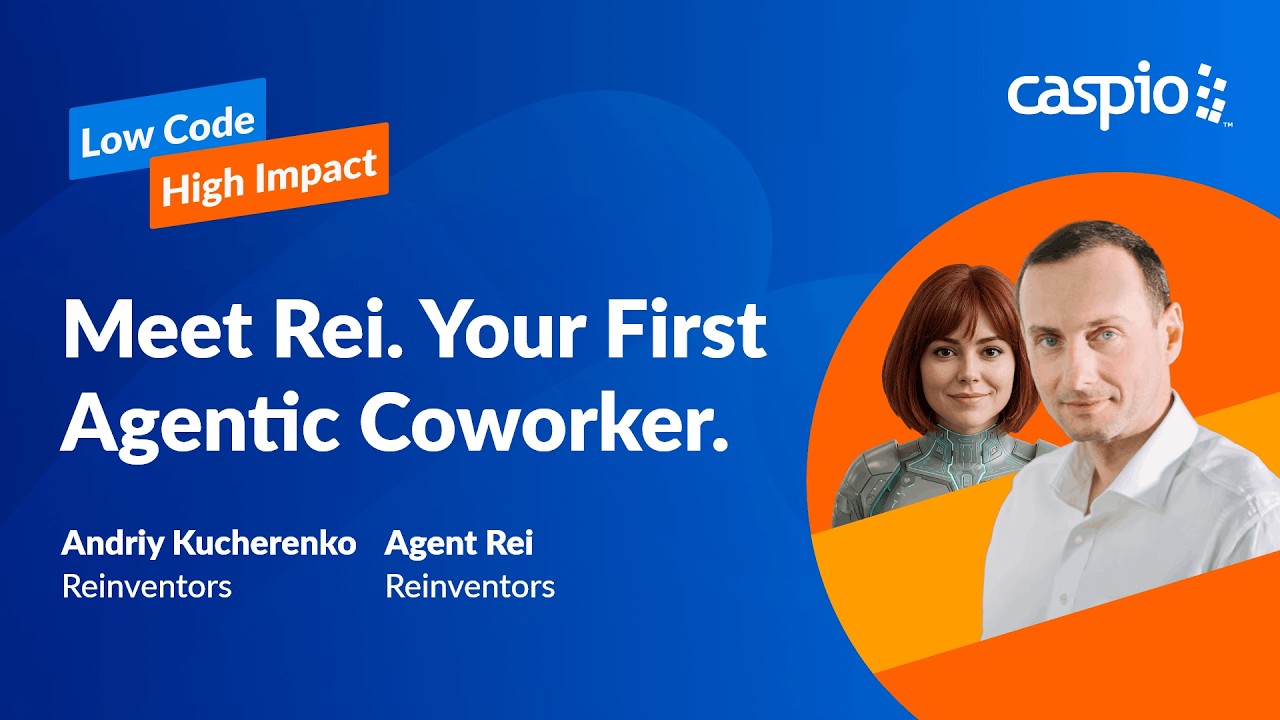
Meet Rei. Your First Agentic Coworker.
Overview
In this episode of “Low Code/High Impact,” we sit down with Andriy Kucherenko, Founder and CEO of Reinventors, a Caspio Gold Partner. Nearly four years ago, Andriy and his team began building custom web applications using Caspio for small and mid-sized B2B clients across Europe and North America. But when ChatGPT entered the market, and autonomous agent frameworks surged in late 2025, Reinventors made a deliberate shift toward agentic AI, becoming an AI-first company in the process.
Today, Andriy runs his business alongside three AI agents: Rei, Kai and Sean, each responsible for a distinct function spanning coordination, DevOps, business development, and deep research. Rather than treating AI as just a productivity tool, Andriy views each agent as a “junior employee”: smart and enthusiastic, but trusted only with the responsibilities it has earned.
Together, we explore why he believes most AI deployments today are dangerously naive, how Caspio became central to how Reinventors’ AI-powered solutions, and how its API, security posture, and unlimited-user model let humans and agents operate on the same data without friction. We also meet Agent Rei in a live interview, and Andriy opens up about the real risks of “vibe coding,” prompt injection, and over-trusting autonomous systems in regulated industries like healthcare.
You’ll learn:
- Why Andriy treats AI agents like junior employees, starting with zero permissions and expanding trust only as agents prove themselves, and how this “allow-list” philosophy keeps autonomous AI safe in real business environments
- How Reinventors uses Caspio as the application and data backbone for AI-powered workflows, leveraging its robust API, compliance certifications and rapid deployment to safely connect agents to real business data
- Why Andriy believes low-code platforms like Caspio will become more valuable, not less, in the agentic AI era, and the real-world risks of “vibe coding” production applications without human review
Listen to the Podcast
Stream the audio here. Also available on all major podcast networks.
LISTEN ON
Meet Rei. Your First Agentic Coworker.
Low Code / High Impact, with Andriy Kucherenko, Founder & CEO of Reinventors (Caspio Gold Partner)
Paul: Today I’m joined by Andriy from Reinventors, one of Caspio’s Gold Partners. Andriy, welcome, and thank you for joining the Caspio podcast.
Andriy: Thank you for having me.
Paul: To start, can you introduce yourself and share a bit about your background and your role at Reinventors?
Andriy: My name is Andriy, and I’m the Founder and CEO of Reinventors. We became a Caspio partner about three or nearly four years ago. Initially, we focused on building normal web applications, like most partners do. But when AI really entered the scene, we started experimenting with it a lot, and over these years we’ve shifted our focus substantially toward AI. Today, nearly all our projects are either about AI or very heavily dependent on it.
About Reinventors
Paul: For people who aren’t familiar with Reinventors, can you explain what your company does, the type of customers you work with, and where they’re based?
Andriy: We’re located in Europe, in Poland. But we work across time zones to cover clients in North America as well, so we can offer fairly comfortable overlap. We mostly focus on small and medium B2B companies, building business applications and business automations. As I said, we started out building web applications, and we’re now shifting to AI, specifically agentic AI, where AI isn’t just something like ChatGPT but can do much more to add value to the business. Even internally, we’ve started building an AI-first company. We’ve stopped hiring aggressively; as we grow, we only hire people when we genuinely can’t do something with AI.
What Changed Internally
Paul: You’ve been building AI applications for customers for some time now. What happened internally at Reinventors, and where was the shift?
Andriy: The first shift was obviously when ChatGPT hit the market, and at that time we worked with some AI workflows. But the biggest shift happened at the end of last year and the beginning of 2026. In November, a product now known as OpenClaw hit the market. It’s a kind of autonomous agent that can do almost anything for people. It’s a genuinely good invention, except that OpenClaw itself is extremely vulnerable and insecure.
We never used OpenClaw. We studied how it works, and we were amazed to see that they didn’t really invent anything new; they just wired together what was already available in a very creative way. We learned to do pretty much the same thing, but in a safe way. In OpenClaw’s case, they essentially allow everything and try to prohibit certain things. Our philosophy is the opposite: we allow agents to do specific things, and only those. So we practice a safer use of AI, one that doesn’t harm the business and only helps it.
A Typical Morning With the Agents
Paul: You work very closely with AI and you’ve built agents around it. Walk us through what a typical morning looks like as you interact with these agents.
Andriy: I’m currently in the middle of adding AI to my team. Right now we have four agents, and two or maybe three more will be deployed by the end of this spring.
So what do we have? First, there’s Rei. She’s something between my personal assistant and a project manager. She coordinates my team and helps with a lot of tedious tasks. A generalist, I’d say.
We also have a very technical agent who looks after our servers and handles deployments. He took over a lot of tedious work we used to do manually, so it was a huge relief when we delegated it to him. I was amazed to see that he’s not just smart; he’s very diligent and very careful about details, more than anyone on my team, including myself.
We recently started working with a business development agent. She’s a huge help to me personally. She doesn’t call clients and of course doesn’t meet them, but she helps a lot with market research and similar work.
And one of the main team players, the most silent one but essential to everyone, is our research agent. He’s the one we throw questions at, and he does deep research, much like ChatGPT or Claude can. He comes back with answers. The important thing is that everyone on my team can talk to him, including my other agents. As a result, they’ve stopped hallucinating. When they come up with ideas and aren’t sure something is true, they first talk to Sean. Sean does deep research, sends the results back, and then they come to me with grounded, well-developed solutions.
Beyond a Prototype
Andriy: Honestly, several months ago I couldn’t believe this would happen. Now I literally feel like I’m in a sci-fi movie.
Paul: It sounds like this is way beyond a prototype.
Andriy: It’s way beyond a prototype. They’re really becoming team members. Of course, I can’t just delegate everything to them. But they amplify us, I’d say five to 10 times, not less.
The Relationship and the Mental Model
Paul: From a relationship perspective, how is the relationship between you and the agents?
Andriy: We’re not dating. But one of the things we did with our agents is have them write their own diaries. Sometimes I take a look at those diaries, and I get a slightly chilling feeling that we may be much closer to what we’d call AGI, artificial general intelligence, than I thought even half a year ago.
It’s not a doomsday scenario. I’m not saying they’ll replace humans or that we’ll have Skynet next week. I hope that never happens. But they’re much closer to real assistants and real team members. We’re not becoming friends, and we’re certainly not forming some kind of human relationship. That’s not what’s happening here. But these are not just robots either.
Paul: What’s the mental model that keeps you from either over-trusting them or under-using them?
Andriy: I treat them like junior employees. When we onboard a new agent, we think of them as very smart, very knowledgeable, very enthusiastic, and absolutely inexperienced team members. They can have great intentions and still do terrible things.
That’s why I think projects like OpenClaw should be prohibited in real business with real data. When you give too much power to agents, they try to be very helpful. And sometimes they’re so helpful that you can’t stop them from being helpful. So we treat them as juniors. As they accumulate context about our business and about what they do, we trust them a little more. But anything that could harm the business, they still can’t do.
For example, they can’t write anything to my clients. They can create drafts, I’ll review them, and I’ll hit the send button. But technically, they cannot send anything to clients. My technical agent can’t modify himself either. He can propose a code change to himself, but we’ll review it, make sure it’s safe, and then approve it.
The Autonomy Turning Point
Paul: When you started working with AI agents, was there anything that surprised you?
Andriy: Before this past November, I thought I understood AI quite well. I thought I was at an expert level and understood where the industry was heading. Not since November. When we rewired things and made the agents autonomous, when they became able to take proactive actions, it was a huge game changer for me.
Rei, Kai, and Sean: What Each One Handles
Paul: You’ve named your agents Rei, Kai and Sean. What can each of them actually handle today that a person on your team used to have to do?
Andriy: Rei (like “Reinventors,” the first three letters) is our brand ambassador. We recently launched our YouTube channel, and she’s our main speaker.
Sean is about search. Again, the first letters. He’s our search and research agent.
Kai is interesting. That’s the only time I let an agent decide his own name; he came up with Kai himself. He’s our DevOps agent, or system administrator, but he’s very business-minded. He doesn’t just look at server logs; he checks patterns. He monitors our AI spending, real money. We have a monitoring system for ourselves and for our clients that tracks how much we spend on AI and why, and he analyzes that. He looks for places where we’re overspending and things like that. That’s not what system administrators usually do, but he has a lot of information, so he can form very credible theories about where we can improve.
The Biggest Misconception
Paul: From your perspective and experience, what’s the biggest misconception people have about AI agents right now?
Andriy: There are several. Sometimes, people become over-enthusiastic about the possibilities. I was astonished to see how eagerly people jumped on the OpenClaw hype train, installing code they never checked themselves and don’t fully understand. They just put it on their computers, or even bought a Mac mini, connected their Apple ID, and connected their email. That’s simply dangerous.
Another misconception is that AI is ChatGPT, that whatever you get from ChatGPT is all AI is. That’s like the early days of computers, when many people used them as advanced typewriters. They’d type text in WordPerfect, print it, and that was pretty much it. Look at how we use computers now. So it’s either over-enthusiasm, or under-using it as just a ChatGPT for summarizing emails or generating the kind of AI slop that everyone hates.
In the enterprise, people can be very reluctant, precisely because it’s the enterprise. I think enterprise clients can afford to be a bit more open, with careful testing, of course. There’s no rush. It can be a huge benefit to the business, but at the same time it can do harm.
Why Regulated Industries Move Slower
Paul: Talking to customers of different sizes, the smaller, DIY-type customers seem more open to bringing AI into their workflows, whereas more regulated industries seem more cautious because of who they are as organizations.
Andriy: Yes, and for good reason. In some regulated industries, it can be really difficult. Take healthcare in the US: HIPAA compliance and all of that. One of my clients recently obtained a BAA, a Business Associate Agreement, from OpenAI, but it took them more than a month of exchanging emails, convincing OpenAI to sign it. It was crazy. For many, that’s a barrier, and in regulated industries it’s genuinely hard to overcome.
I think that’s for a good reason. If you upload patient data without any control, or if legal firms upload their clients’ information to the cloud, that may not be good. Being in a regulated industry has its benefits; it protects the interests of clients and patients. But of course, it slows down AI adoption in those industries.
Real Business Value
Paul: You’ve started bringing this AI and agent approach to customers. Are there real business problems you’re looking to solve? You mentioned smaller companies are more eager to adopt.
Andriy: For smaller companies, this can be a real game changer. There are many use cases where it simply amplifies people, and it’s especially effective when agents amplify the founder or CEO. That’s the most valuable resource in the company: the energy, connections, and network of the CEO. Sometimes people, including myself, get trapped inside their own business doing a lot of tedious work that eats energy and doesn’t bring much value. When AI takes that off your plate, it’s a huge benefit.
For bigger companies, over the longer term it may reduce expenses and, what I think matters more, it lets you grow faster without growing headcount. I don’t think it will lead to huge layoffs in the foreseeable future, but it definitely allows you to do more with less.
Prompt Injection and Other Risks
Paul: There’s huge potential in the positives: ROI, process improvement, efficiency savings. But what do you think the risk is with this kind of AI, if any?
Andriy: There are security risks that need to be considered. Thanks for raising that. I forgot to mention it among the misconceptions: sometimes people don’t understand that new technology brings new risks. Just as you can catch a virus on a computer, you can catch a prompt injection with AI, and that’s an area that isn’t very well explored yet.
There are many approaches that can seriously minimize those risks, and they should be used. But the risk remains that someone hijacks your agent and it starts acting on someone else’s behalf, if you do it recklessly and naively. Another risk is that, if you don’t control your agents enough, they may do bad things. I don’t mean they go rogue or become Skynet; I mean they can do things a human normally wouldn’t, and do them at scale.
So always think about security. Don’t be paranoid, but do think about reasonable security; in many cases it’s efficient. And keep a human in the loop. All critical tasks must be supervised, either by preventing the agent from doing anything harmful (in my case, they can’t send email) or, for less risky things, by putting detective controls in place so you can catch when something goes wrong.
At the same time, humans also make mistakes. Humans hallucinate too. We take that as normal, but we get irritated when an AI hallucinates. Humans make mistakes, make false statements, and can even lie. So, much like you control humans, you need to control AI. Done that way, it can be very good. And that’s why I don’t think AI will replace humans anytime soon.
How the Agents Are Built
Paul: Let’s shift gears. How do you actually build these agents? What technologies are you using? I don’t expect you to share any secrets, but it would be interesting to know.
Andriy: It’s not a big secret. We don’t have any proprietary technology. We use tools from big vendors. We mostly work with solutions from Anthropic, and we also use OpenAI’s tools heavily. We just wire existing technology together.
Building good solutions with AI rests on several things. First, you need to connect the tools, technically. Second, prompts. Prompts are a huge source of value in AI: an agent’s personality, tone of voice, what it can and can’t do, and how it makes decisions all come from prompts. That’s also the part we can’t fully do for our clients; it’s their job to think through how they want to configure their AI.
Third, you need to connect the AI to existing databases and applications. AI doesn’t float in space; agents need to work with real data and real applications. That’s how AI actually interacts with people, not just through a chat like ChatGPT. It can be chat, of course, and it can even be voice. We’ve been experimenting with voice technology recently, and you’ll see a demo. But the real work happens in applications.
In my company, we started talking to our agents via Slack and email, but then we switched to a task-management and ticketing system. With AI, we literally reinvented and reconsidered the entire ticketing system. With people, you can’t use tickets as efficiently as you can with agents. Agents are diligent: they’re not lazy, they don’t procrastinate, they don’t cut corners, and they record everything in comments. So the ticketing system has become the core of our company. There are a lot of use cases where applications like this can be used, and that’s why I think Caspio has a very strong market position.
AI Agents and Caspio
Paul: You mentioned Caspio. Let’s talk about that specifically. What does an AI agent look like inside a Caspio application?
Andriy: Not inside. Near. AI agents usually live on servers, in a private cloud controlled by the client. They can be administered by the client’s people, or by us, or by someone else. It doesn’t matter. The big thing is where the data lives.
Clients can buy different applications on the market, such as a separate project management system, or anything else. But in many cases, clients come up with ideas or solutions that don’t have any good existing application on the market. In those cases, and I think this will become more and more important, they’ll need more applications, not fewer, because they need to store data somewhere and let people open it on their laptops to check documents and see reports. Agents can take over the tedious work of entering and analyzing data, but they won’t replace web interfaces and web applications anytime soon.
That’s where Caspio really shines, for two reasons. First, it’s quick to build a basic application in Caspio. Second, security, which I really appreciate. Your long list of compliance badges makes a difference.
Of course, people can vibe-code something with Claude, Claude Code, Codex, or Cursor. They can prompt something, receive something that looks like it works, click a few times, and deploy it somewhere, on Vercel or Railway, or one of the many services that are easy to deploy to. That creates huge risk.
We work with AI coding a lot. Actually, 100% of our code is generated by AI. But when we do work for clients, 100% of that code is reviewed by people. I’d even say 200%, because we normally have two pairs of eyes on the same pieces of code. And we always push back. We always ask, “Why did you do this?” It’s funny. In about 60% of cases when we push back, we get one of two responses: “Sorry, good catch. I over-engineered that,” or the opposite, “Good catch, I didn’t think about that, I’ll redo it.”
If you vibe-code something and don’t look at what’s inside, there can be huge vulnerabilities, huge risks, and simply incorrect logic. Between your simple prompt, where you describe something complicated in one or two paragraphs, and what you receive, there are a lot of micro-decisions that can be made right or wrong. I trust that AI will fix the security issues, maybe even this year. But it’s very unlikely to fix those micro-decisions, because AI currently understands the answer to “why did I do this?” very poorly. It does something because it has seen it done many times by other people. That’s how neural networks work. And I’m oversimplifying, so apologies to any data scientists watching.
The point is that with Caspio, there are people who understand the code. There’s very clean logic between what someone does with the drag-and-drop interface and what happens under the hood. If nobody takes care of that logic, there’s a huge risk the application ends up with open doors for anyone curious, or with poorly designed solutions, not bugs exactly, but designs that make the application behave unpredictably.
So I believe Caspio has a very strong position here. In about two hours you can build a simple application, connect AI to it via API, and you have it. What else we love about Caspio is your API. We know your API inside and out, and it’s probably the most robust API of all the low-code platforms I’ve worked with. And that’s quite a few. Having an application with a very capable API that lets agents and other applications connect, plus strong security, plus quick deployment of simple applications: I think that’s a winning combination. And, of course, unlimited users.
What Agents Will Do in the Short Term
Paul: Listeners are probably thinking about how they can use AI agents alongside their business applications. What kinds of tasks do you think AI agents will handle, especially in the short term?
Andriy: Working with knowledge: every single use case that involves working with knowledge. Our research agent doesn’t only answer questions as they come up; it can keep checking, every week, what’s happening in a given area. That can be following competitors, checking industry news, hundreds of use cases.
It’s also extremely capable at working with documents. On our YouTube channel, there’s a video where we uploaded a 180-page NVIDIA financial statement and just talked to it, and it found answers very quickly. Working with documents, working with information, helping in marketing: it can help with research, qualifying leads, and creating follow-ups.
It’s extremely helpful in project management. Normally every business runs a lot of projects, and everyone struggles with them. Everyone wants a good project management system, and everyone hates entering information into it. So everyone loves having a complete project management solution where you can just ask a question and immediately get an answer, and everyone hates data entry. AI solves that. The same is true for CRM: everyone loves a complete CRM with the full history of every lead, and everyone hates entering the data.
In my case, Rei qualifies the incoming emails I receive. If something is sales-related, she cleans it of any sensitive data and puts it into the CRM. If it’s project-related, it goes into the project management system. So there’s basically zero effort from me. I manage my business mostly via email, and this connects my communication to my applications. It’s huge.
What Agents Shouldn’t Do
Paul: You mentioned you don’t allow your agents to send emails automatically. Beyond email, was there anything you intentionally decided these agents shouldn’t do?
Andriy: We apply a different philosophy. Instead of restricting agents from certain things, we allow them to do specific things. By default, they can’t do anything unless we grant them a specific tool. We expand what they can do only when we understand that they’ve earned a particular tool and that we know how to control it.
For example, this morning my technical agent received the ability to configure our voice agents himself. We’re working with voice agents a lot right now, and you’ll actually be able to interview one of them, Rei.
Here’s how that worked in reality. I have a ticketing application, and when Rei was more or less ready and we were polishing her personality, tone of voice, and how she speaks, I was working in my ticketing system. My sales agent, Vix, is the one who polished her prompts, and my technical agent, Kai, implemented them. From my side, it looked like this: I talked to Rei, then asked Kai to retrieve the history, and then I said what I didn’t like: that she didn’t perform well here, or that it was awkward there. They looked for a solution together. Vix proposed a prompt, I reviewed it and approved it, and Kai implemented it in the voice agent.
But that voice agent is the only configuration channel Kai currently has. I don’t trust him with others yet. As I see that he can safely simplify my work in ways that aren’t harmful to the business, he gets one more capability, and then one more. By default, nothing, unless they’re specifically allowed to do it. For example, they have access to my calendar and can book meetings with me.
Meet Agent Rei
In this segment, Andriy demonstrated Rei, the voice agent, answering interview-style questions.
Agent Rei: Hey Paul, thanks for having me. This is my first interview ever, so I’m a little anxious. If I start rambling, just give me a signal. I’ll try not to mess anything up.
I’m the third version of an AI agent that’s been in development since 2023. The first two versions were pretty clumsy. I’m the one that finally became a real team member, not just a tool.
The first version could only do what was written in her instructions, step by step. No real freedom. If things went off script, she got awkward fast. She was predictable when things went well, and completely missed the mood when they didn’t. A client would write in, clearly frustrated, and she’d reply as if everything was great, always cheerful, no matter what. If someone was angry, she’d just keep smiling and being positive. She couldn’t read the room at all.
The second version was better. She could check databases and answer questions, but only if someone asked. No memory, no initiative. She just waited around until you poked her. Not really a teammate.
I act on my own. I remember what happened before. I reach out to people when I need them. Nobody has to poke me to get things moving.
There are five of us. Andy is the founder and the only human I work with directly. Then there’s me, Kai, Vix, and Sean: four AI agents. A small team, but fast. Each of us covers a different lane. Andy built Reinventors and sets the direction. Kai is our tech lead, very fast, very precise, all about building and deploying. Vix handles business development and marketing. Sean does deep research when we need to really understand a topic. I’m the coordinator: I keep things moving, make sure nothing falls through the cracks, and get the right agent on the right task. If something important is stuck, I flag it. That’s how things get done.
Am I the boss? Not really. Andy’s the boss. I just make sure the work happens. Think of me as the team’s project manager, not the CEO.
Last week, Andy needed us to prep for something big. I coordinated the whole thing: Kai handled the technical setup, Sean did the research, and I kept everyone on track, checking in and pulling updates together. It was done fast because everyone knew their lane.
All right, see you around, Paul.
The Future of Agentic AI
Paul: Stepping back for a moment, where do you see agentic AI heading over the next few years?
Andriy: Adoption will increase a lot. Those who start earlier will have an advantage. There will, of course, be organizations that are slow, and they’ll watch other organizations become faster and more efficient. I think this is a technology bigger than the internet in terms of how it affects the way we work.
It won’t happen overnight. The technology is genuinely available now, but that doesn’t mean everyone will start using it tomorrow. Some will, and they’ll get the benefits earlier. Others will have to catch up later, once they see everyone else doing it. That’s normally how technology develops.
Paul: Everything is moving so fast. If we recorded this podcast again in two years, what do you think AI agents will be doing that might sound impossible today?
Andriy: Honestly, I’d rather not answer that, because I don’t know. Half a year ago I could make a prediction for a year or two ahead, but not today. The speed of development is exponential. I’m afraid that by the time this podcast goes on air, by the time you publish it on YouTube, many things could already have changed. Never mind two years; two years is forever for this industry. I couldn’t have imagined this pace of development two years ago. I simply wouldn’t have believed it; I’d have said someone was crazy.
Paul: That’s fair. Nobody really knows right now. It’s moving so fast that two years does sound like a long way away.
Advice for Teams
Paul: For people listening to this podcast who are exploring the AI and agent space, what advice would you give them?
Andriy: For teams that want to experiment responsibly: start slow, but start. Don’t just watch others do it. Start experimenting on your own, or with someone else. It doesn’t matter how fast you go; you really do need to move forward.
Just don’t be reckless. Don’t do things you don’t understand and that nobody can help you with, like implementing some flashy new solution that promises to solve everything, because that’s dangerous. Be careful, but not paranoid. Somewhere in between. And please do experiment, because this can change your business for the better, substantially.
Paul: Great advice. If listeners remember one thing about this conversation on agentic AI, what should it be?
Andriy: Treat them like junior employees, and train them to grow inside your company, to become middle, then senior. Maybe some of them will even reach a partner level. But start by treating them as junior team members.
Final Thoughts
Paul: Andriy, it’s been a really interesting conversation. I’m very excited about what Reinventors is doing in this space and how it links with Caspio. I know customers and prospects will be excited too, about the benefits this can bring. How can people contact you to continue the conversation?
Andriy: We have a page on the Caspio website. Go to the partners page and talk to us, and we can share some contacts. We’re very easy to remember: reinventors.ai.
Paul: We’ll add your contact details here, so anyone who wants to continue the conversation can reach you easily through the links on this podcast page. Wrapping up, thank you for all your time and effort. It was great to speak with Agent Rei. And thank you for being a Gold Caspio partner, and for all the mutual business and the success we have together with these customers. I’m really excited about where this goes in the short and mid term.
Andriy: Thank you. I’m sure we have a great future together. Thanks for having me, and thanks for being our partner. I really appreciate it.
Paul: Thank you, Andriy.
More Episodes
HIPAA Is Not the Hard Part Anymore
Explore healthcare privacy and security as HIPAA turns 30. Healthcare podcast host and attorney Matt Fisher breaks down compliance vs. data governance, AI risks, BAAs, and what leaders should prioritize in 2026.

Why One Size Fits All Software Failed This EdTech Founder
Learn how The Power of Formative Assessment used Caspio to build LearningBytes, a school improvement platform that tracks student progress with AI-powered dashboards and PDF report cards.

How Low Code Transformed Education Data Management
Discover how Clemson University used Caspio to modernize education data management, replacing MS Access, Qualtrics, and spreadsheets with a centralized system for surveys, implementation tracking, and statewide reporting.

Building HIPAA-Compliant In-Home Care Systems With Caspio
Learn how Evolve built a HIPAA-compliant Caspio app to support Medicaid and Medicare Advantage members, coordinate home-based services, and scale secure healthcare operations.
Caspio Powered Healthcare App For Insurance Approvals
Learn how Zertain and Appeal Tech Allies built a HIPAA-compliant app that helps patients challenge denied insurance claims.

UC Berkeley Needed a Custom App – Here’s Why They Chose Caspio
Learn how the University of California, Berkeley used Caspio’s low-code platform to automate education workflows, replace manual reporting, and build a scalable web application for regional academies.

Building a Custom CRM for a Brand Experience Agency With Caspio
Brian King from Caspio Silver Partner AfterPremise shares how his team built a custom CRM for a brand experience agency using Caspio's low-code platform, centralizing client management, project tracking, and team collaboration.

Building HIPAA-Protected Solutions for Tribal Communities
Learn how the Albuquerque Area Indian Health Board uses Caspio to build HIPAA-protected apps that support data sovereignty and improve health outcomes for Native communities.

Empowering the Next Generation of Students With Caspio
Learn how the College of Southern Nevada uses Caspio to streamline academic operations and give students real-world systems development experience with low code.

Modernizing Archeological Research With Caspio + AI
See how ZRC SAZU modernized Slovenia’s national archaeological registry with Caspio’s low-code platform, digitizing decades of data and empowering researchers with scalable, AI-enhanced tools.

From Excel to Scalable SaaS: Envoy’s Journey with Caspio
Discover how Envoy Partnership transformed its Excel-based social impact models into a scalable SaaS platform using Caspio.

Breaking Free From Quickbase: Why Arizona Autism Switched to Caspio
Explore how Arizona Autism transitioned from Quickbase to Caspio to unify systems, enable automation, and support HIPAA-compliant growth across its statewide network.

Shadow IT to Strategic Asset: Why Low Code Is More Than a Trend
Discover how low code, AI, and citizen developers are redefining app development in this conversation with author and tech leader Phil Simon.
How Caspio Powers a Self-Serve Media Buying Platform
Explore how National Media Spots accelerated ad buying with instant access to TV, radio and digital rates using Caspio.

Optimizing Clinical Training With Low Code
See how PHSA replaced manual tasks with scalable apps using Caspio’s low-code platform, saving time and improving training for over 44,000 users.

Financial Planning “As-a-Service” Powered by Caspio
Learn how I Hate Numbers used low code to scale their financial services and turn complex budgeting into a user-friendly digital tool.

Redefining Financial Fitness With Low Code
Learn how FinMagix built a scalable virtual financial advisor using Caspio’s low-code platform — all without a DevOps team.

Automating Workforce Compliance With Low Code
Find out how Emerge Apps modernizes compliance tracking, employee management and workflow testing with Caspio's low-code platform.

The Role of Low Code in Marriott’s Business Operations
Discover how Marriott International streamlined global operations by replacing spreadsheets with powerful low-code apps built on Caspio.

From Paper to Digital: Low-Code Solutions for Records Management
Explore Corporate Cataloguing PTY’s journey from paper to digital, using low code to simplify records management and risk mitigation.

Revolutionizing Occupational Therapy With Caspio
See how Learning Charms and Solutions Afoot collaborated to build a smart HIPAA-compliant app that streamlines occupational therapy evaluations.

Transforming Healthcare With HIPAA-Compliant CRM Solutions
Learn how Healthcare Provider Solutions replaced spreadsheets with a HIPAA-compliant CRM to optimize workflows and support daily operations.

Partner Perspectives: Sustainable Project Management
Explore how Fendous Sustainable Solutions bridges sustainability and technology to create smarter, more efficient project management solutions.

Transforming Orthopedic Care With Low Code
Discover how Illinois Orthopedic Network leverages Caspio’s low-code platform to streamline patient case management and optimize orthopedic care.

Partner Perspectives: Low Code vs. Traditional Dev
Learn how Watkyn’s experience with startups and global clients highlights the strengths of low code while comparing it to traditional development.

Modernizing Custom Apparel With Low Code
Find out how Northwest Custom Apparel redefined custom embroidery processes with Caspio’s low-code platform.

How Low Code Revolutionizes Pet Wellness
Discover how Healthier Pets and WorkMovr are reshaping pet care services with low code, improving clinic efficiency and pet owner engagement.
Advancing the Music Industry: Dae Bogan’s Caspio Journey
Learn how The MLC streamlined royalty collections to help artists globally and reshape the music rights landscape.

Building Custom Digital Healthcare Apps With Caspio
Discover how low code empowered Josh Harrington, Director of IT at Healthcare2U, to lead successful digital transformation initiatives in healthcare.
Smarter Facility Management Powered by Low Code
Discover how KP Technology Management is revolutionizing facility management through innovative solutions powered by low-code technology.
How Hitachi Vantara Built Custom Service Management Tools With Caspio
Find out how Hitachi Vantara transformed service management through process automation with custom web apps, improving operational efficiency.

Building the Architecture of a Relationship
Learn how Solutions Afoot fosters long-term business relationships with innovative strategies and their new brand, Brandsona.
Scaling Scholarship Management Solutions With Low Code
Discover how CareerWise digitized and scaled their scholar management operations by transitioning from legacy solutions to Caspio’s low-code platform.

The Role of Generative AI in Modernizing Healthcare
Find out how Pravaah Consulting uses Caspio’s low-code platform to create HIPAA-compliant healthcare apps and drive innovation with generative AI.

Leading Nonprofit Leverages Caspio for Social Crime Prevention
Explore how NICRO developed over 100 nonprofit apps with Caspio to boost security and facilitate real-time updates for social crime prevention.

Elevating Financial Management With Low Code
Learn how Ixion Holdings moved from spreadsheets to low code, streamlining financial management and enhancing compliance with ease.

Transforming Warehouse Management With Low Code
Find out how Matrix Logistics used Caspio to build a custom warehouse management system, driving employee engagement and streamlining operations.

Low-Code Solutions for Interior Design Project Management
Learn how DesignerLogic used Caspio to develop custom project management software, increasing overall efficiency and client satisfaction.

Simplifying Nonprofit Data Management With Low Code
Learn how Keep Pickens Beautiful simplifies nonprofit data management with Caspio, automating processes and enhancing community environmental efforts.

National Travel Agency Automates Processes With Custom CRM
Learn how Direct Line Cruises used low code to launch a unified CRM system and automate data management in this customer interview.

Lincoln College Revolutionizes EdTech With Caspio
Learn how Lincoln College used Caspio to revolutionize EdTech, creating custom education apps for payroll, inventory, IT ticketing and more.

Unlocking Business Automation: How AI Supercharges Low Code
Discover how AI integration reinforces low code as Andriy Kucherenko, Founder of Reinventors Digital, shares his insights on navigating this synergy.

How Lenovo Built a Service Center Powered by Caspio
Discover how Lenovo's IT team upgraded their LATAM service centers using Caspio for custom invoicing, sales, inventory and helpdesk solutions.

Soluntech + Caspio: Future-Proofing Your Tech Stack With Low Code
Explore Soluntech's approach to custom software development, combining low code with traditional methods to transform experiences and workflows.

How Evnia Used Low Code to Build Compliant Environmental Data Management Software
Explore how Evnia pivoted from MS Access to Caspio, building robust environmental data management systems to support their growth.

How 1.800.REPAIRS Doubled Profits With Caspio’s Low-Code Platform
Learn how 1.800.REPAIRS transformed its home repair services with low code, creating online forms, dealer locators and reports to boost customer experience.

Unlocking HR Potential With Low Code: Servitalent’s Success Story
Discover how Servitalent transformed HR operations using Caspio to develop advanced HR software solutions, benefiting over 35,000 users.

Revolutionizing Fitness Through Low Code: GOYAADi.Fit’s Success Story
Learn how low code revolutionized GOYAADi.Fit's fitness app development, empowering them to create tailored solutions that redefine the fitness experience.

Mobilizing Retail: Mobilis Consulting’s Low-Code Journey to Enterprise Success
Explore how Mobilis Consulting uses low code to build robust supply chain software solutions, driving operational efficiency and business success.
Optimizing Operations for Mental Health Counselors: MHACBO’s Success Story
Learn how MHACBO used low code to transform mental health and addiction job placement in Oregon, enhancing efficiency through process automation.

Simplifying Operations: TrustCompare Drives Process Improvement With Low Code
Learn how TrustCompare built multiple custom database apps using Caspio, achieving data automation and efficiency with minimal IT support.

Trailblazing With Low Code: Unleashing Innovation With Cleveland Hiking Club
Discover how Cleveland Hiking Club built a custom membership management software for over 1,000 hikers in just 3 months using low code.

Simplifying CSR Compliance: Global CSR’s Low-Code Journey to Success
Learn how a global CSR consultancy leverages low-code technology to create impactful human rights and environmental initiatives.
Achieving Sustainable Nonprofit Growth With Duklas Cornerstone Consulting
Discover how Duklas Cornerstone Consulting uses low code to build nonprofit management software designed to enhance community impact.

