HIPAA Database Software: How to Choose a Compliant Platform in 2026
April 24, 2026

HIPAA-compliant database software must provide four things: a signed Business Associate Agreement (BAA), encryption in transit and at rest, role-based access with audit logging, and safeguards verified by independent certification rather than vendor self-attestation. Caspio provides all four with its published HIPAA add-on, with HIPAA and SOC 2 Type II independently certified annually.
The stakes are severe. HIPAA fines can reach millions of dollars per violation category, and many healthcare teams still run patient data through spreadsheets, legacy systems, and patchwork tools that were never designed to meet HIPAA requirements. This guide explains what makes database software HIPAA-compliant in 2026 and how to choose a platform.
HIPAA database software is a platform that meets the security requirements of the HIPAA Security Rule for storing, processing, and transmitting electronic protected health information (ePHI). It provides encryption, access controls, audit logging, authentication mechanisms, and a signed Business Associate Agreement (BAA) between the healthcare organization and the software provider.
The right HIPAA database platform does more than check a compliance box. It gives healthcare organizations the tools to build applications that improve patient care, streamline operations, and scale without exposing sensitive data.
This guide covers what makes database software HIPAA-Compliant, the features you should look for, and how platforms like Caspio deliver the security and flexibility healthcare organizations need.
What Makes Database Software HIPAA-Compliant?
HIPAA compliance is not a single feature or certification. It is a set of requirements defined by the U.S. Department of Health and Human Services (HHS) that any entity handling protected health information (PHI) must satisfy. For database software, compliance means meeting the administrative, physical, and technical safeguards outlined in the HIPAA Security Rule.
The Three Safeguard Categories
These three safeguard categories work together to protect ePHI across people, processes, and technology.
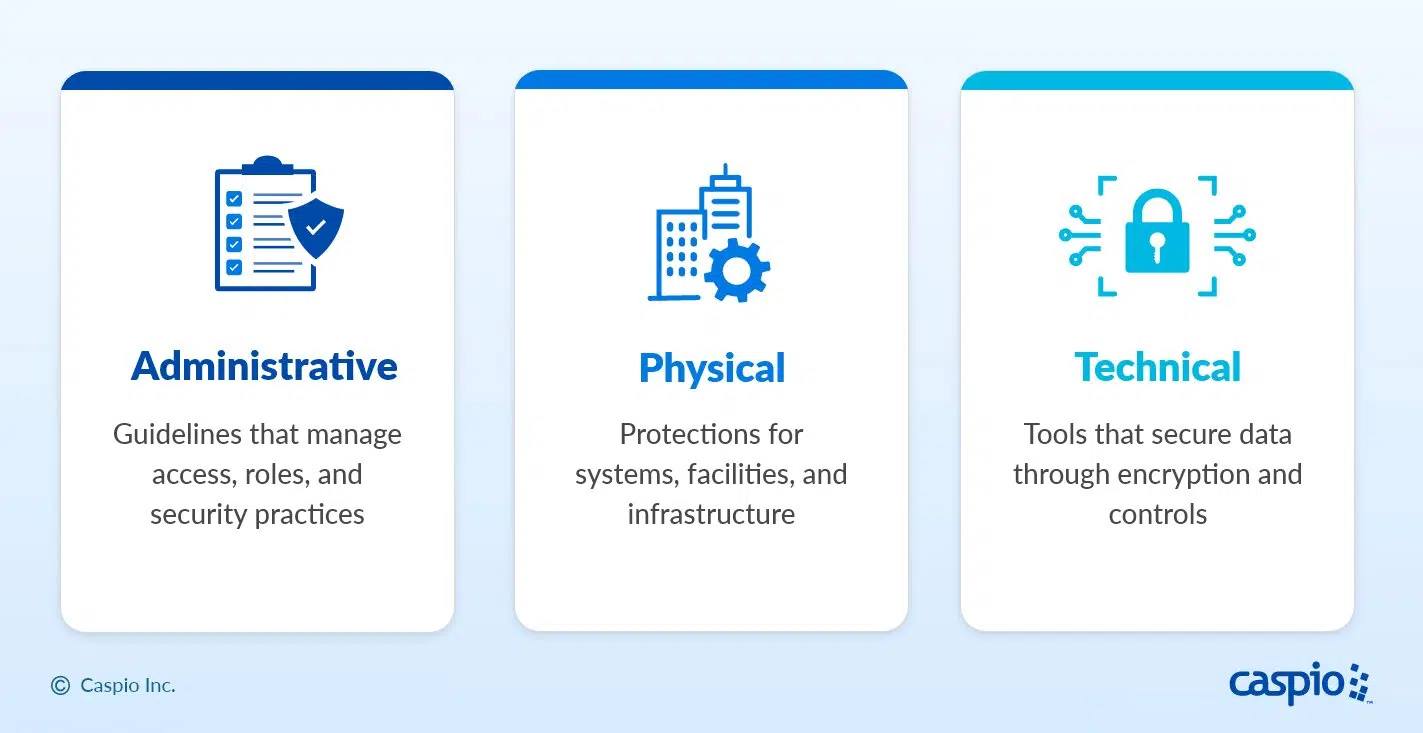
WHERE COMPLIANCE TAKES SHAPE: This approach combines governance, secure environments, and technical controls to protect ePHI at every level.
Administrative safeguards include policies and procedures that govern who can access ePHI, how workforce members are trained, and how the organization responds to security incidents. A compliant database platform supports these safeguards by offering role-based access controls, user management, and activity logging.
Physical safeguards protect the hardware and facilities where ePHI is stored. For cloud-based database software, this responsibility falls primarily on the infrastructure provider. Platforms hosted on enterprise-grade cloud infrastructure like Amazon Web Services (AWS) inherit physical security controls such as restricted facility access, environmental protections, and redundant systems.
Technical safeguards are the technology-based protections that control access to ePHI and protect it during storage and transmission. These include encryption, authentication mechanisms, audit controls, and integrity controls.
The Role of the BAA
Any third-party vendor that creates, receives, maintains, or transmits ePHI on behalf of a covered entity is classified as a business associate under HIPAA. A database software provider that stores patient data is a business associate.
Before a healthcare organization can use a database platform for ePHI, the provider must sign a Business Associate Agreement (BAA). This contract specifies:
- The types of PHI the business associate will handle
- Allowable uses and disclosures of that PHI
- The security measures the business associate must implement
- Breach notification obligations
- Requirements for returning or destroying PHI when the relationship ends
A database platform that refuses to sign a BAA, or does not offer one, is not suitable for healthcare data.
2026 HIPAA Security Rule Updates
The HIPAA landscape is evolving. The proposed modifications to the HIPAA Security Rule, published in December 2024, represent the most significant update since 2013. Key changes expected to take effect in 2026 include:
- Elimination of “addressable” vs. “required” distinctions: All implementation specifications become mandatory, regardless of organization size.
- Mandatory encryption: Encryption at rest and in transit using NIST-aligned standards will be required for all ePHI.
- Multi-factor authentication (MFA): No longer an optional safeguard.
- Network segmentation: Required to limit the impact of potential breaches.
- Annual compliance verification: Covered entities must obtain written confirmation from business associates that required safeguards are in place.
- 72-hour recovery standards: Organizations must demonstrate the ability to restore critical systems and data within 72 hours.
These changes raise the compliance bar significantly. Choosing a database platform that already meets or exceeds these requirements protects your organization from scrambling to comply when the updated rule takes effect.
Key Features to Look for in HIPAA Database Software
Not every database that claims HIPAA compliance actually delivers the full set of protections healthcare organizations need. Here is what to evaluate when selecting a platform.
1. Data Encryption at Rest and in Transit
Encryption is the foundation of ePHI protection. Your database software must encrypt data while it is stored (at rest) and while it moves between systems (in transit). Look for platforms using AES-256 encryption or equivalent standards aligned with NIST guidelines.
2. Role-Based Access Controls (RBAC)
The principle of least privilege is central to HIPAA compliance. Your platform should let you define granular permissions so that each user, from administrators to front-line staff, only accesses the data they need for their role. Record-level security adds another layer, restricting visibility to specific rows of data based on user identity.
3. Comprehensive Audit Logging
HIPAA requires the ability to track who accessed ePHI, what they did with it, and when. Audit logs must capture read, write, edit, and delete operations across all access points, including applications, APIs, and administrative interfaces. These logs should be stored securely and separately from the primary data environment.
4. Authentication and Identity Management
Strong authentication mechanisms protect against unauthorized access. Look for support for multi-factor authentication (MFA), single sign-on (SSO), session timeouts, and password complexity enforcement. These controls become even more critical under the proposed 2026 HIPAA Security Rule updates, which make MFA mandatory.
5. Signed Business Associate Agreement
As discussed above, a signed BAA is non-negotiable. The platform provider must formally accept responsibility for protecting ePHI within their systems.
6. Dedicated or Isolated Infrastructure
Some platforms run all customer data on shared infrastructure. For HIPAA compliance, look for providers that offer a dedicated environment, where healthcare data resides on infrastructure that is physically or logically separated from non-compliant workloads.
7. Backup, Disaster Recovery, and Business Continuity
Data loss is a compliance violation. Your database platform must provide automated backups, geographic redundancy, and tested recovery procedures. Under the proposed 2026 rules, you will need to demonstrate 72-hour recovery capability through quarterly-tested restoration processes.
8. Integration Capabilities With Compliance Maintained
Healthcare organizations rarely operate in isolation. Your database must integrate with EHR systems, billing platforms, scheduling tools, and communication systems without breaking the compliance chain. Look for secure APIs, webhooks, and integrations with HIPAA-compliant automation platforms.
9. Scalability Without Compliance Gaps
A platform that meets compliance requirements on a small scale but cannot maintain those protections as your organization grows is a liability. Evaluate whether the platform supports increasing users, data volumes, and application complexity without requiring you to rearchitect your compliance approach.
How Caspio Meets HIPAA Requirements
Caspio is an AI application platform with annually certified HIPAA and SOC 2 Type II compliance and unlimited users, used to build secure business apps for healthcare, government, education, and finance. Backed by more than two decades of low-code platform engineering, Caspio enables healthcare organizations to build custom, data-driven applications without traditional software development. Its HIPAA Edition is purpose-built for organizations that handle protected health information, providing the administrative, technical, and physical safeguards required by the HIPAA Security Rule.
Dedicated HIPAA Infrastructure
All Caspio HIPAA customer accounts reside on entirely separate infrastructure dedicated exclusively to HIPAA-compliant applications. This infrastructure runs on Amazon Web Services (AWS), providing enterprise-grade physical security, environmental controls, and redundancy. The separation ensures that healthcare data is not commingled with non-compliant workloads. For organizations with data residency requirements, Caspio also operates regional site deployments, including an EU Compliance Edition.
Encryption
Caspio encrypts all data in transit and at rest. Data moving between users and applications is protected via TLS encryption. Data stored within the Microsoft SQL Server database on AWS is encrypted at rest. This dual-layer encryption satisfies both current HIPAA requirements and the mandatory encryption provisions in the proposed 2026 Security Rule update.
Role-Based Access Controls and Record-Level Security
Caspio provides granular role-based access controls that allow administrators to assign permissions aligned with specific job functions. Record level security restricts data visibility at the individual row level, ensuring users see only the patient records or data sets relevant to their role. This implementation of least-privilege access directly supports HIPAA’s minimum necessary standard.
Audit Logging
System-wide audit logs in Caspio record all user access to data, including read, write, edit, and delete operations through deployed applications, APIs, and within the account. These audit logs are encrypted and stored in a separate environment from the primary data, providing tamper-resistant records that support compliance reporting and regulatory audits.
Authentication
Caspio supports multi-factor authentication (MFA), single sign-on (SSO), two-factor authentication (2FA), automatic session timeouts, and configurable password policies. These controls protect against unauthorized access and satisfy the authentication requirements that are becoming mandatory under the proposed 2026 HIPAA Security Rule.
Business Associate Agreement
Organizations using Caspio’s HIPAA Edition receive a signed BAA confirming Caspio’s responsibilities in safeguarding PHI stored and processed within their applications. Caspio also maintains BAAs with its own vendors that handle PHI, supported by regularly updated compliance policies.
Compliance Certifications
Caspio holds multiple compliance certifications relevant to healthcare and regulated industries:
- HIPAA-compliant with signed BAA, independently certified annually
- SOC 2 Type II-certified, independently audited and certified every year, demonstrating rigorous ongoing evaluation of security, availability, processing integrity, confidentiality, and privacy controls
- ISO 27001 standards through AWS infrastructure
- FIPS 140-2-compliant GovCloud Edition hosted on AWS GovCloud for federal-grade protection
The platform also supports compliance with FERPA, PCI DSS, GDPR, WCAG, ADA, and Section 508 accessibility standards, making it suitable for healthcare organizations that operate across multiple regulatory frameworks.
Healthcare-Specific Integrations
Caspio integrates with Keragon, a HIPAA-compliant automation platform that connects over 300 healthcare tools and systems. This integration enables healthcare organizations to securely automate workflows across EHR systems (including Athenahealth and ModMed), CRMs, communication platforms, scheduling tools, and analytics systems, all without writing code and without breaking the compliance chain.
Additionally, Caspio supports an agent-ready REST API, webhooks, Zapier, Make and n8n for custom integrations with billing systems, analytics platforms, and other healthcare software.
Healthcare Use Cases Built With Caspio
Caspio’s combination of annually certified HIPAA compliance and rapid application development has enabled healthcare organizations to build and deploy custom applications across a range of use cases.
Hospital Data Management: Emory Healthcare

Emory Healthcare, one of the largest healthcare systems in the Greater Atlanta area with 10 nationally recognized hospitals and approximately 4.1 million patient visits per year, turned to Caspio to modernize their data management. Their Director of Decision Support, Shane Wieberg, led the transformation from spreadsheet-based processes that consumed significant productivity hours to a centralized, interactive reporting system built on Caspio. What started as a supplemental tool evolved into a full-scale financial analysis dashboard used by over 70 operating units, incorporating data collection, verification, approval workflows, and drill-down reporting. Reports that previously took two weeks to produce became available in minutes.
Home Healthcare Operations: Nightingale Home Healthcare

Nightingale Home Healthcare provides in-home nursing services across 11 states with a distributed workforce of over 500 employees managed by a single headquarters IT team. They used Caspio to build applications that replaced paper-based processes, including an IT ticketing system, time-off request workflows, appointment scheduling tools, and training certification tracking. These applications were deployed on Nightingale’s intranet, providing remote nurses with easy access and helping the organization achieve their goal of going fully paperless.
HIPAA-Compliant CRM: Healthcare Provider Solutions

Healthcare Provider Solutions (HPS), serving homecare and hospice agencies, replaced complex Excel-based workflows with a HIPAA-compliant CRM built on Caspio. Their custom portal now supports over 1,000 daily users and delivers real-time analytics, simplifying operations and turning their data management system into a competitive advantage.
Additional Healthcare Applications
Caspio provides pre-built templates and video tutorials for common healthcare use cases, including:
- Patient portals with secure access to medical history, medications, allergies, prescriptions, test results, and appointment scheduling
- EHR systems with data-driven document generation, automated scheduling, reminders, and secure patient communication
- Referral management systems for inbound and outbound patient referrals
- Resource scheduling for staff shifts, facility management, and equipment allocation
- Clinical research databases with role-based access and record-level security for external collaborators
- Compliance tracking and reporting dashboards
Explore more healthcare applications you can build with Caspio’s AI application platform, including clinical data repositories, patient intake systems, and searchable directories designed for HIPAA-compliant workflows.
Caspio vs. Other HIPAA-Compliant Database Options
Several platforms offer HIPAA-compliant database capabilities for healthcare organizations. Here is how they compare across key dimensions.
Caspio vs. Quickbase
Quickbase is an established no-code platform with a deep compliance program: its annual SOC 2 Type II report includes independent attestation to the applicable HIPAA Security Rule safeguards (45 CFR 164.308, 164.310, and 164.312), and it carries additional attestations such as SOC 1 Type II and DFARS/NIST 800-171 (Quickbase Trust Center).
The differences show up in access and cost structure. Quickbase’s own compliance page states that a BAA applies to customers on Business and Enterprise subscriptions with annual or multi-year contracts, and that customers remain responsible for ensuring apps are designed and maintained to meet their compliance needs. Quickbase also prices per user, so costs scale with headcount. Caspio signs BAAs with its published HIPAA add-on, priced at $500 per month on top of any plan’s rate with a one-year term, and every Caspio plan includes unlimited users, which matters for patient portals and partner-facing apps where user counts are unpredictable.
Best for: Quickbase suits enterprise operations teams already standardized on per-user licensing. Caspio is the stronger fit when external or unpredictable user volume makes per-user pricing unworkable, or when you want a BAA at a published price.
Caspio vs. Airtable
Airtable’s familiar spreadsheet-style interface makes it one of the fastest tools for small teams to adopt. For healthcare use, however, HIPAA support with a BAA is available only on its Enterprise Scale plan through a Health Information Exhibit. And Airtable’s own health-information datasheet, updated July 23, 2026, adds a further layer for AI: “Airtable AI is available to customers with an executed Health Information Exhibit, Business Associate Agreement (BAA), or other equivalent HIPAA/CMIA agreement, who have accepted the Airtable AI Terms, including the Supplemental AI Terms for Health Information,” and it instructs customers: “Do not store ePHI or medical information in workspaces where Airtable AI is enabled, unless you have accepted the Airtable AI Terms, including the Supplemental AI Terms for Health Information” (Airtable Health Information Datasheet, updated July 23, 2026; verified 2026-07-28).
Caspio takes the opposite structure: HIPAA and SOC 2 Type II are independently certified annually at the platform level, the BAA is available at published add-on pricing rather than an enterprise-only negotiation, and users are unlimited on every plan.
Best for: Airtable suits lightweight collaborative trackers that never touch PHI. Caspio is the fit when patient data is the point of the application.
Caspio vs. Traditional Cloud Databases
Enterprise cloud databases like Amazon RDS, Google Cloud SQL, and Microsoft Azure SQL Database can be configured for HIPAA compliance and offer BAAs. However, they are infrastructure-level solutions that require significant development resources to build applications on top of.
Where Caspio differs: Caspio is an AI application platform, not raw infrastructure. Healthcare organizations get a HIPAA-compliant database and the tools to build applications on top of it, including forms, reports, dashboards, workflows, and user portals, all without writing code. This dramatically reduces the time, cost, and technical expertise needed to deploy healthcare applications. Organizations that would need months of development with a traditional database can launch with Caspio in days or weeks.
Best for: Engineering teams that want to build and maintain the entire application, access, and audit layer themselves.
Quick Comparison
| Platform | Standard BAA | Certification posture | Pricing and user model | Best for |
|---|---|---|---|---|
| Caspio | Yes, with HIPAA as a published add-on ($500/month on top of the plan rate, one-year term) | HIPAA and SOC 2 Type II independently certified annually; FIPS 140-2 support via AWS GovCloud edition | Flat plan pricing, unlimited users on every plan; AI capabilities on every plan tier: Caspi formerly branded AI Assistant, AI Connector Extensions, Caspio MCP Server, agent-ready REST API | Regulated organizations building PHI apps with unpredictable or external user volume |
| Quickbase | Yes, for Business and Enterprise subscribers on annual or multi-year contracts | Annual SOC 2 Type II report with attestation to HIPAA Security Rule safeguards (45 CFR 164.308/310/312) | Per-user pricing; costs scale with headcount | Enterprise ops teams already on per-user licensing |
| Airtable | Enterprise Scale plan only, via Health Information Exhibit | Airtable AI use with health information requires an executed Health Information Exhibit (or equivalent agreement) plus acceptance of Airtable’s Supplemental AI Terms for Health Information (vendor datasheet, updated July 23, 2026) | Per-seat pricing | Lightweight collaborative tables that never hold PHI |
| Knack | Yes, on HIPAA Core plan from $625/month | SOC 2 Type II report access under NDA | Plan caps apply on HIPAA Core: 125,000 records, 50 GB storage | Small healthcare teams with modest data volumes |
| Blaze | Yes | HITRUST e1 and SOC 2 Type 2; no FIPS 140-2/GovCloud option | Published Internal Apps plan from $1,350/month (internal users only, annual billing); HIPAA requires the custom-priced Enterprise plan | Healthcare-only teams evaluating newer platforms |
| Bubble | No standard BAA as of early 2026; PHI cannot live in Bubble’s native database for HIPAA use | No HIPAA certification published | Consumption-based workload pricing | Consumer-style prototypes that never touch PHI |
| Traditional cloud databases (Amazon RDS, Azure SQL, Google Cloud SQL) | BAA available from the cloud provider (infrastructure layer only) | Provider-level certifications; the application, access, and audit layer is yours to build | Infrastructure pricing plus development cost | Engineering teams building fully custom stacks |
Can You Build a HIPAA-Compliant Database App With AI?
Yes, if the platform underneath carries the certification. AI builds it; the platform it lives on carries annually certified HIPAA and SOC 2 Type II. The build method is not the compliance boundary. The platform is.
The evidence for keeping that boundary on a governed platform is not hypothetical. Escape.tech scanned more than 5,600 publicly available vibe-built apps and found 2,000+ high-impact vulnerabilities, 400+ exposed secrets, and 175 instances of PII, including medical records (Escape.tech, October 2025). In May 2026, security vendor Red Access found that of 380,000 publicly accessible AI-built assets it scanned, more than 2,000 held sensitive data reachable at a public URL with no exploitation required, including a hospital app containing doctor-patient conversation summaries and a UK health company’s active clinical trials, findings independently verified by Axios.
“The end result is that organizations are actually leaking private data through vibe coding applications. This is one of the biggest events ever where people are exposing corporate or other sensitive information to anyone in the world,” Red Access CEO Dor Zvi told eWeek (May 2026).
Getting it wrong is expensive. Healthcare data breaches average $7.42 million per incident, the costliest of any industry for 14 consecutive years, according to IBM’s 2025 Cost of a Data Breach Report (HIPAA Journal, 2025).
The safer pattern is to let AI accelerate the build on a platform where the BAA, encryption, access control, and audit logging already exist and are independently certified every year.
See our guide to the best HIPAA-compliant app builders in 2026 and our buyer’s guide to AI app builders for regulated industries.
A HIPAA Database Your AI Assistants and Agents Can Work With
Choosing HIPAA database software now includes a second question: can your AI tools work with the database safely once it is built? Caspio is an AI application platform, so the answer is structural rather than bolted on. Caspi builds and refines database applications from plain-language prompts, and AI Connector Extensions for leading AI models let healthcare teams enhance the data they already hold and draw insights from it. Caspio’s HIPAA-eligible AI features operate under signed Business Associate Agreements.
Agent access is governed the same way. The Caspio MCP Server, whose server side runs inside Caspio’s certified environment, lets AI assistants and agents query and update your applications through the Model Context Protocol, and an agent-ready REST API, alongside webhooks, Zapier, Make, n8n and Keragon, connects them to the rest of your healthcare stack.
Getting Started With Caspio for Healthcare
Deploying a HIPAA-compliant database application with Caspio follows a structured path designed to get healthcare organizations operational quickly while maintaining full compliance.
Step 1: Choose the Right Plan
HIPAA is available as a $500 per month add-on on top of any published plan’s rate (one-year term); totals start from $800 per month. Enterprise Editions with custom configurations are available for larger healthcare organizations. Visit Caspio’s pricing page to compare plans and contact the sales team for healthcare-specific guidance.
Step 2: Execute the BAA
Once you select a HIPAA-enabled plan, Caspio provides a BAA for your organization to review and sign. This formally establishes Caspio’s obligations for protecting PHI within your applications.
Step 3: Design Your Database
Caspio uses Microsoft SQL Server as its underlying database engine. You can design your data model using Caspio’s visual table editor, import existing data from spreadsheets or other systems, or start from one of Caspio’s application templates.
Step 4: Build Your Applications
Using Caspio’s point-and-click application builder, create the embeddable apps and components your organization needs, including forms, reports, dashboards, and workflows. Caspi can accelerate the build from plain-language prompts. If you’re exploring what to build first, a doctor-patient appointment system is one of the most common healthcare applications. Watch this Caspio Live tutorial to follow each step in the process.
Step 5: Configure Security and Access Controls
Set up role-based access controls, record-level security, authentication policies (including MFA and SSO), and session timeout rules. Configure audit logging to track all data access and modifications.
Step 6: Deploy and Integrate
Caspio applications are deployed as embeddable apps and components that can be integrated into your existing website, intranet, or portal. Connect with EHR systems, billing platforms, and other tools through the Keragon integration, an agent-ready REST API, or webhooks.
Step 7: Monitor and Maintain Compliance
Use Caspio’s audit logs and activity tracking to support ongoing compliance monitoring, internal audits, and regulatory reviews. Under the proposed 2026 HIPAA Security Rule, you will need to formally test and verify safeguards every 12 months, and Caspio’s built-in logging and security features support this requirement.
Frequently Asked Questions
Get quick answers to common questions about HIPAA database software, compliance requirements, and how Caspio supports healthcare applications.
Is Caspio HIPAA-Compliant?
Yes. Caspio’s HIPAA and SOC 2 Type II compliance are independently certified annually, and Caspio signs a Business Associate Agreement with its published HIPAA add-on. HIPAA accounts run on dedicated, isolated AWS infrastructure with encryption, role-based access controls, and audit logging. See our answer page: Is Caspio HIPAA compliant?
What is HIPAA-compliant database software?
HIPAA-compliant database software is a data platform that protects electronic protected health information (ePHI) through a signed BAA, encryption in transit and at rest, role-based access controls, audit logging, and administrative safeguards, with compliance verified by independent certification rather than vendor self-attestation.
Do I need a BAA with my database provider?
Yes. If a vendor stores or processes PHI on your behalf, HIPAA requires a signed Business Associate Agreement that makes the vendor contractually responsible for safeguarding it. No BAA means no PHI, regardless of how strong the vendor’s technical security is.
How much does HIPAA-compliant database software cost?
Caspio prices HIPAA as a published add-on: $500 per month on top of any published plan’s rate with a one-year term, with unlimited users included, for totals starting from $800 per month. For comparison, Quickbase provides BAAs only on Business and Enterprise annual contracts with per-user pricing, and some vendors gate the BAA behind custom enterprise negotiations.
Can a SOC 2 compliant platform also support HIPAA requirements?
Only if it adds the HIPAA-specific pieces. SOC 2 Type II attests to security controls; HIPAA additionally requires a signed BAA and safeguards mapped to the Security Rule. Look for both: annual independent certification of SOC 2 Type II and HIPAA, plus a BAA at published pricing.
Can AI app builders create a HIPAA-compliant database application?
Yes, when the platform underneath carries the compliance. AI builds it; the platform it lives on carries annually certified HIPAA and SOC 2 Type II. Standalone AI code generators typically offer no standard BAA, which is why generated prototypes fail healthcare procurement reviews. On Caspio that means conversational building with Caspi, data enrichment through AI Connector Extensions for leading AI models, agent access through the Caspio MCP Server, and an agent-ready REST API.
Can I build a patient portal with Caspio?
Yes. Caspio provides a HIPAA-ready patient portal template and the tools to build custom portals with secure logins, role-based access, and record-level security, delivered as embeddable apps/components on your own website. Integrations include an agent-ready REST API, Webhooks, Zapier, Make, n8n and Keragon for healthcare workflows.
What healthcare systems does Caspio integrate with?
Caspio connects to healthcare systems through Keragon, a HIPAA-compliant automation platform linking more than 300 healthcare tools, including EHRs such as Athenahealth and ModMed, plus scheduling, billing, and communication systems. Caspio also supports an agent-ready REST API, Webhooks, Zapier, Make, n8n for custom and cross-platform integrations.
Will Caspio meet the 2026 HIPAA Security Rule requirements?
Caspio already implements the controls at the center of the proposed Security Rule update, including encryption at rest and in transit, access controls, and audit logging, and its compliance program is re-certified through annual independent audits, so customers inherit updates at the platform level.
Get Started With a HIPAA-Ready Platform
Building the right HIPAA database software is one of the most consequential technology decisions a healthcare organization can make.
The platform you select must protect patient data, satisfy regulators, and give your team the tools to build the applications that improve care delivery and operational efficiency. Start a free trial of Caspio to see how a purpose-built, compliant platform can support your healthcare workflows.


Recommended Articles

Online Database With a SQL Backend: 7 Questions to Ask
READ STORY
Best Bolt.new Alternatives for Business Apps (2026)
READ STORY
9 Vibe Coding Security Risks in AI-Generated Apps
READ STORY
Build Custom Business Apps Easily: 3 Patterns
READ STORY
Caspio AI Connector Extensions: 5 Jobs for Your Tables
READ STORY
PHI and Caspio AI: Which Features Your BAA Covers
READ STORY
How AI Agents Buy Software, and Why Legibility Wins
READ STORY
10 Questions to Ask Before Connecting AI to Business Data
READ STORY
Add a Role-Aware AI Chat Agent to Your Caspio App
READ STORY
Build Internal Tools With AI: Best Tools for Business (2026)
READ STORY
Vibe Coding vs. Low-Code: Key Differences and Where Caspio Fits in 2026
READ STORY
Lovable Alternatives for Business and Regulated Apps (2026)
READ STORY
